|
Getting large audiences for cultural events, more so for theatre, has always been an issue and hence cultural organisations like the NCPA have been innovating on ideas to draw more crowds.
Since last year, the NCPA has been organising exciting theatre festivals, dedicated to showcasing offbeat theatre in different languages, like the Pratibimb festival for Marathi plays, the Centrestage festival which features multilingual plays, the Ananda festival showcasing Hindi plays, and the Vasant Theatre Festival for Gujarati plays. The second edition of the festival took place from 23rd to 25th March 2012.
That Gujarati theatre in Mumbai has had its dedicated audience is known to all. Gujarati theatre sees many new productions each year and has been tagged as commercial theatre, a concern that some grapple with and which some seize. The NCPA Vasant Gujarati Theatre Festival this year lacked the excitement and ambience of what is expected of a festival. Unlike the first edition of the festival in 2011 which comprised extended programmes such as talks and discussions, participation by various known and new groups, and (dare) not to miss, Gujarati cuisine, the second edition was as drab and dry as the heat that has hit Mumbai. There was no springtime (Vasant) joy to be had.
The festival featured three plays. To begin on an ironical note, all three plays had English titles - TRUTH AND DARE, COME ON ADITYA and HAPPY ANNIVERSARY. Two of the three plays focused around topics related to the younger generation, the ones who failed to make it to the plays, because hardly ten percent of the audience comprised of youngsters. Nonetheless, the three plays reflected on a gamut of subjects head on - personal relationships, love, sex, friendship, teenage life, ambition, marriage, divorce, generation gaps, addiction to technology, aspects of trust, ego, fear, forgiveness - all which form part of our personal lives.
|
|
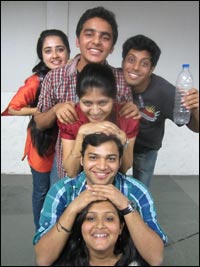
| Forget the popular Bollywood dance numbers that the act began with, and TRUTH AND DARE, written and directed by Hussaini Dawawala, unraveled a number of revealing personal stories, interweaved in the lives of five college friends. Five best friends get separated from each other due to misunderstandings, ego issues and lack of trust. A mysterious anonymous letter to all the five friends brings them together one evening. The predictable follows... A series of small episodes through the game of truth and dare unfurl the reality, bringing the friends back together. Just that, it took a 'deadly' intervention to make this happen and bring the friends together again. The last scene reveals that the one character who got the friends together is someone who had risen from the dead to do a good deed, to make up for the mistakes he had made in his life. With this unreal twist, suddenly, the play starts to look fragmentary, where random smaller stories have been weaved together to make one large story.
The actors are excellent and characters are interesting, but what garners interest is the fast pace by which the bits and pieces come together to form the theatrical mosaic, with song, dance and all things entertaining. The play hurtled around with multiple blackouts on stage, taking the audience from one event to another, in time and space, skillfully creating an illusion of multiple stage platforms within the not-so-large stage.
|
|
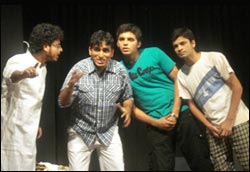
| COME ON ADITYA, written by Pravin Bhandare and directed by Dharmendra Gohil, told the story of a good young boy who had dreams of starting a sports club that supported sports among children who could not afford it. Suddenly, his dreams get smashed when he is exposed to the real money-minded world. The play also focuses on the vices and effects that technology has caused, making addicts and socially alienated youngsters and further fuelling the problems arising out of the generation gap. But it is the family who finally restores Aditya's confidence. The characters, some funny, some intense, ably fit in the times we live in, but the story tells nothing new.
While the first two plays concentrated on innovative dramaturgy and deft acting, the plain and mundane dialogues in Hindi, English and Gujarati were the core drawbacks. With hardly any dialogues to applaud, a lot of the dialogues were in English and Hindi, missing the essence of the Gujarati language. Perhaps, a situation that has led to this is that that Gujarati youngsters themselves do not understand and speak their language well enough, although one could overhear animated discussions about the content of the plays amongst the older generation during the intervals.
|
|
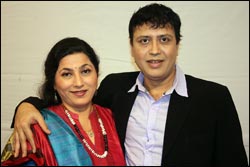
| The last play of the festival-- Avni Production's HAPPY ANNIVERSARY, deftly manages to traverse more than a decade of time in the two hours, with just two actors on stage. A husband and wife decide to get divorced on their 15th wedding anniversary, and from hereon unfurl painful personal moments. With a lot of events taking place in the family like the couple's separation, the husband's second marriage, them becoming grandparents of their daughter's baby, the son's wedding day amongst other happenings, the play feels like glancing through a family album. The scenes are snappy with quick dialogues that capture the tumultuous and the subtler sides of a couple who has been together for years but has now reached a point of separation.
While the wife portrays a character that is at once strong and painful, it does leave a question: Where do we subsequently locate her? Does she safely fit into the social code -- a woman of strength who constantly breaks down only to build herself each time -- a woman who constantly struggles and is full of forgiveness towards her husband at the end? All in all, her character is surely a memorable one. But overallI wonder... For how long can we care for this genre of social drama on stage, in play after play?
*Jigna Padhiar is a freelance arts and culture writer based in Mumbai. She is currently working with the India Foundation for the Arts as their Mumbai representative. She has a degree in Art History and Aesthetics. Previously she has worked with English dailies as an arts' correspondent.
|