|
The Delhi Ibsen festival, which celebrated its fifth edition in the first week of December 2012, followed by a seminar is a niche festival, curated by Nissar Allana of the Dramatic Art and Design Academy (DADA) in Delhi, and supported by the Royal Norwegian Embassy in India. Seven plays were staged at the main festival with four productions from India, and three productions from outside the country - from neighbouring Pakistan, from Uzbekistan in Central Asia and from Norway-the land of the great dramatist. University productions by students in Delhi were commissioned for the festival, but except for Ramjas College, the other colleges and universities were not part of the main festival. We got to know about these productions during the seminar following the festival, where students made presentations and described the processes and their experience.
One of the highlights of the festival, and the opening play, was Ibsen's THE MASTER BUILDER by Padatik, Kolkata, and directed by Wlodzimierz Staniewski of the Gardzienice Theatre in Lublin, Poland. Staniewski, who is regarded as an iconic figure, created his own style of theatre after his split with the famous Jerzy Grotowski. Staniewski was specially invited to direct this production for Padatik and though the result is far from satisfactory, given that the director had only three weeks with the group, it has a distinct European character to it. One can see the director's stamp all over the production, whether one may agree or disagree with his interpretation of the text. Staniewski chooses to dispense with the dialogic form and uses the monologue to establish Master Builder Solness and his wife Aline Solness' characters. Kaia Fosli, from the play, is rendered mute, more out of an exigency it seemed, as actors Sanchayita Bhattacharjee (who played Aline Solness) and Mahmud Alam (he played Dr Herdal) said in their presentation at the seminar. Stepping in for Staniewski who could not stay back for the seminar, Mahmud Alam, with interventions from Sanchayita Bhattacharjee, presented a succinct insight of the director's methodology, broken down into the main modules of his work- process.
On the subject of Kaia Fosli (Rina Mitra), Staniewski was keen to cast a young actress but Paditik's theatre wing didn't have girls of the suitable age. When Staniewski saw Padatik's dance company's classes, he not only found his Kaia Fosli (on the condition that he would not have her speak as she was a dancer and not an actress), but he also discovered that he could integrate Padatik's dancers in the production, thus giving a playful form to the idea of the 'troll' in Ibsen's text. With Dinesh Poddar's light design, Staniewski creates frame-like pictures and vivid images for a few scenes. This lends depth to the scene in which Aline Solness recalls the burning down of her mother's house, the loss of her two children thereafter, but even more poignantly, the burning of the dolls that she held close to her heart.
The movable set with its thick frame and multiple doors however seemed like an idea that was lost and appeared as clunky as the uneven performances. Also jarring was the manner in which different actors enunciated their speech differently, a typical problem with Indian English productions of plays from the West. Our actors also tend to be mannered, and a production like this demands 'unlearning'. Sanchayita Bhattacharjee and Mahmud Alam in their presentation at the seminar were humble to say that if Staniewski's ideas were not realised, the blame lay with Padatik. But I gather that had both the director and the group invested a little more time, it would have led to a solid production.
Kerala-based Sankar Venkateswaran's work stands out for two reasons. In the first instance, as Sankar said while describing his idea of theatre at the seminar, that he finds the use of words problematic while presenting a play that is removed from his cultural and linguistic context. Hence if he has to present Ibsen's plays in English or in Malayalam, it would be first 'once-removed' and then 'twice-removed'. Therefore Sankar prefers to work with movement and the body of the actor. This choice also makes Sankar's theatre distinct. While movement-based and physical theatre is not new to India, Sankar's style of minimalist theatre attempts to internalise the movement, charting out a landscape of ideas and images through the actor's body.
|
 |
|
|
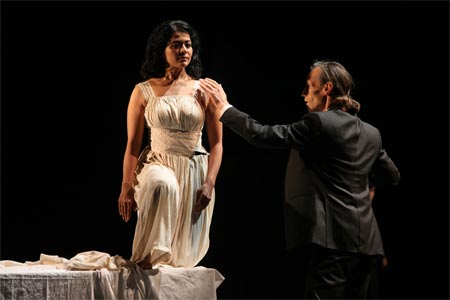
WHEN WE DEAD AWAKEN, directed by Sankar Venkateswaran. Urs Dietrich as Professor Rubek and Kavita Srinivasan as Irene |
|
His interpretation of Ibsen's WHEN WE DEAD AWAKEN (Ibsen's last play, published in 1899), while following the key scenes in the text, replaces all the words with the physical imagery that his actors create in tandem with the stage design, props, lights and with music and sound. But the production appears to be an extension of his earlier production of THE WATER STATION. In that sense, the stylisation with Ibsen had a sense of deja vu and appeared like a repetition of his earlier work. On the other hand, it still led to powerful moments like the drop of the shovel from above the stage, which is symbolic in its reference to the breakdown of the relationship between Professor Rubek and his wife Maia. Similarly, the effect of an avalanche, created towards the end of the play also adds to the visual beauty. WHEN WE DEAD AWAKEN is Ibsen's most philosophical play perhaps; autobiographical and more modern too vis-a-vis his earlier work. Here, Sankar takes a page from the play (or rather its core idea of an artist - a sculptor and his muse, who are inseparable, and yet conflicted) and uses the stage as a canvas to paint his own picture of the play.
The intent is bold but the realisation is far more challenging to communicate. Here, the onus lies on the actors, and words when sparingly used in a production like this, must retain the mood or take the text a notch higher. Unfortunately, this does not happen in this production, and on the contrary, when the words are employed, they contaminate the silence which has assumed a character of its own. Niranjini Iyer's Maia (apt for the part) does not jar as much as Kavita Srinivasan's Irene when they speak. In terms of the sheer manner in which the actors move, Urs Dietrich who plays Professor Rubek, stands out for his co-ordination and rhythm that are a highlight of the opening scene.
The spoken text in Sankar's version is reduced to a few words, and this is a dramatic departure from a playwright who is a master of the spoken word. This erasure of the text was a theme that was constantly discussed during the festival and during the seminar, leading to the view that Ibsen in the 21st century can be read (or not read) in ways where the staging need not be text-based, or it could take off from the symbolic references in Ibsen's plays.
Call me old fashioned but I feel Ibsen's plays, have a lot than can be explored. Besides to break Ibsen's rules, one must know them well. This point needs to be underscored, especially for young people who think of Ibsen as 'verbose', or not catering to their sensibility. Perhaps, it would also be helpful for young people to have an intermediary who knows and understands Ibsen, so as to make useful interventions while encouraging new ideas and approaches to Ibsen's plays. It isn't for nothing after all that the master dramatist's works continue to find relevance in this day and age, which is why a there is a legitimate need for the Delhi Ibsen fest.
|
 |
|
|
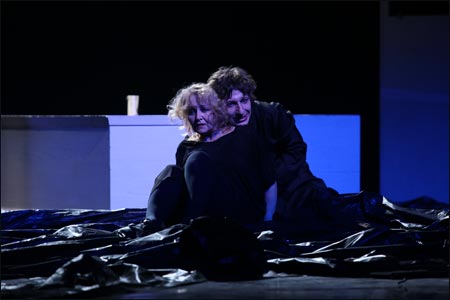
GHOSTS, directed by Ovlyakuli Khodjakuli. Aleksey Pistov as Oswald Alwing and Marina Turpisheva as Mrs Alwing |
|
With Ibsen's GHOSTS, produced by Ilkhom theatre from Uzbekistan, director Ovlyakuli Khodjakuli takes an other-worldly view of the play; what with it being performed by the 'ghosts' that haunt Mrs Alving. The actors appear with white, doll-like masks on the stage; one or two of the actors then get off the stage, approach an audience-member who sets the actor free, so that he can return to the stage as if resurrected from the grave. This ritualised opening piece marks the style of the production, which takes on a hyper-surreal tonality.
All the characters from the original play appear and the structure and text stays true to the original. Yet the production is streaked with overt sexuality, and overplays Captain Alwing's sexual depravity. Adding to the cauldron of unbridled sexuality is Olga Volodina's portrayal of Regina Engstrand, who is also Mrs Alwing's maid. And if that weren't enough, the Pastor (Moldakhanov Seydulla) strips his religious garb and Mrs Alwing makes love to her son Oswald (Aleksey Pistsov). The director hints at the oedipal complex between the mother and son in this. Amongst the actors, Marina Turpisheva as Mrs Alwing delivers a strong performance.
|
 |
|
|
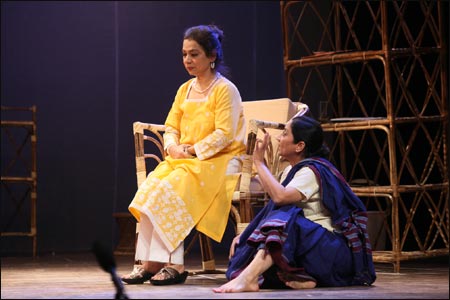
GURRYA KA GHAR (A DOLL'S HOUSE), directed by Anwer Jafri. Mahvash Faruqi as Tehmina and Sheema Kermani as Sakina |
|
One of my favourite productions at the festival was GURRYA KA GHAR (an Urdu adaptation of A DOLL'S HOUSE) by the Karachi-based, Pakistani group Tehriq-e-Niswan. It was a delightful surprise. Writer-director Anwer Jafri condenses the original text to a production that is about an hour long. The staging is good, old-fashioned, realist theatre. The adaptation deftly eliminates characters such as Dr Rank. In this production, Nora is replaced by the upper, middle-class doting wife and mother Tehmina (Mahvash Faruqi).
Setting his adaptation as a rehearsal of the play, Anwer Jafri is able to dispense with the hassle of an actual set and thereby 'experiment' with theatre conventions such as getting the stagehands to actually be a part of the play. To some extent this works, but the movement by the stagehands gets to be distracting for a production that is otherwise played out realistically. Interestingly though, this choice of looking at the proceedings as a 'rehearsal' - 'drama' as separate from real life, also works in a patriarchal feudal society that find a woman walking out on her husband and from her home, unacceptable. Whoever has heard of such a thing is summed up by the maid Sakina, played by Sheema Kermani, one of the founders and leading members of Tehriq. Sakina tells Tehmina that the dilemmas encountered by the women of her mistresses' class are more in the nature of which sandals might go best with the new suit to be worn for Id.
And, so it is for this little familial universe in which women need not be perturbed with the 'big' issues and where husbands like Murad (Saife Hasan) are the norm. In providing a progressive presence to the maid, Anwer Jafri makes a statement on class, but there is no glorification of the maid's purported independence. All the actors do a fine job, and the production is also an example of good basic theatre. The production dates back to 2006, and has been presented five times in Pakistan since then. Tehriq, since its inception in the late 70s, has been grappling with women's issues and the choice of a play such as A DOLL'S HOUSE, bolsters the group's ideology.
|
 |
|
|
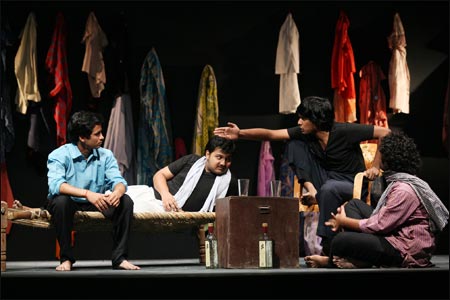
JAI JAWAN PARTY (THE LEAGUE OF YOUTH), directed by Shubham Bhatia |
|
Students are enthusiastic, as it was proved by the staging of JAI JAWAAN PARTY (an adaptation of Ibsen's LEAGUE OF YOUTH) by Ramjas College. Writer-director Shubham Bhatia, whose adaptation has a distinct Indian idiom, locates his play in a village in Uttar Pradesh. But after a promising start, the production ends up as a poor cousin of the UP-oriented Bollywood films which are the norm these days. Borrowing elements from Nautanki and street theatre, the play which is about a young man wanting to replace the old guard (in this instance, the Pradhaan of his village), is a critique of how youth with their revolutionary views, and political idealism, cannot dislodge the status quo. Stensgaard, the young protagonist from the original play who forms the new party 'The League of Youth' is also an opportunist who uses his charm and youthful appeal, but has to leave the town.
In Bhatia's adaptation, not only is the young protagonist shown as toppling the older man, the play also ends with a cliche that suggests how power corrupts all. The actors deliver their parts with great conviction, although they lapse into predictable characterisation, which delights the audience (one notable scene is, where three old men comment on the tactics of the 'Jai Jawan Party'). The problem lies in part with one part of the play aiming to be true to Ibsen's original, and the other, which has been exploited by Hindi filmmakers. The subtler nuances of the original are lost due to an overdone setting, drawing its inspiration from Bollywood instead of a rich text.
Yet, there are things to commend about the production such as the off-stage musicians appearing in the uniform of band musicians leading a baarat. The stage could be less cluttered though and the young director's choice of having one actor not playing the same character is a distraction for a production which is quite realistic, otherwise.
|
 |
|
|
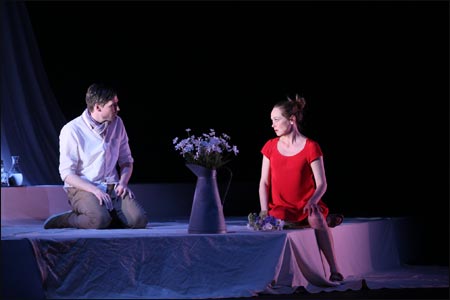
LADY FROM THE SEA, directed by Anne-Karen Hytten. Marianne Nielsen as Ellida Wangel and Audun Sandem as Lyngstrand |
|
The National Touring Theatre of Norway's (Riksteatret) production of LADY FROM THE SEA stayed faithful to Ibsen's original text with minor 'experiments' which broke with the realistic conventions of theatre. It was played on a bare stage; the raised platform had as its centrepiece a flowing cloth, shaped like a falling cone in a symbolic reference to the sea that haunts the play's heroine Ellida Wangel.
The production, directed by Anne-Karen Hytten is engaging and aided by good performances overall but the director has made interesting choices. Marianne Nielsen's Ellida is restrained in her style and that prevents a more layered reading of her character, racked by her desire to embrace the mysterious and the alluring depths of the sea; to be a free spirit on the one hand but to be held back by convention and society on the other. THE LADY FROM THE SEA proves yet again, how Ibsen in his own, unique way understood women and the burden of a patriarchal society. THE LADY FROM THE SEA is a philosophical-metaphorical play about how humanity is land bound and lost touch with its deeper nature that is linked to the vast, open and seemingly boundless sea and its depths. In constructing a heroine who pines for the sea and for the stranger who repels and beckons her, Ibsen has achieved a masterstroke of combining psychology, biology and social critique.
The stranger's (Are J Rodsand) character is rendered non-significant by the Director and which like Marianne Nielsen's restrained portrayal of Ellida takes away the air of mystery that shrouds the play. Interestingly though, Dr Wangel's (Lasse Kolsrud) character comes across as a tad more humane - he attempts to understand his wife Ellida and help her instead of being reduced to a symbol of the chains that confine her. He is not an obvious villain. It appears as if the director wanted to stress on the aspect of Ellida and Dr Wangel's relationship in the play, alluding to the sea and the stranger as perceived threats that must be taken care of so that the family can go on living normally and harmoniously. There is no deviation from the original text but it depicts different interpretations of the text and the characters.
|
 |
|
|
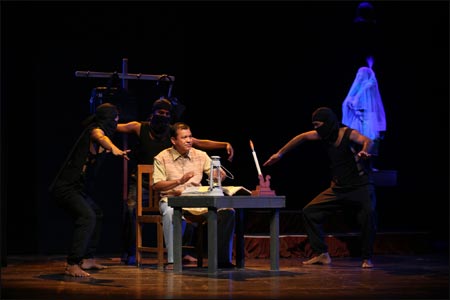
MEEYAMGI YEKNABA (AN ENEMY OF THE PEOPLE),
directed by Heisnam Tomba |
|
The festival concluded with Heisnam Tomba's Manipuri adaptation of AN ENEMY OF THE PEOPLE (MEEYAMGI YEKNABA), a superb piece by Ibsen about corrupting power, hypocrisy, individual conscience and of how the people (the masses) can outcast the very person who was once a hero. Tomba, who has also directed the production, uses the actors and their voice and sound to accentuate their characters with movement. His adaptation, like previous other productions of Kalakshetra Manipur, is able to achieve local resonance and make it lyrical. This is a musical, but the singing which is interspersed with dialogues, does not take away the incisive social critique the play is making. But in adaptations like Tomba's, or even Sankar's for that matter, it's difficult to deny the fact that not enough justice is being done to the original texts.
Tomba's directorial style uses strong visual motifs; there's a fine image of the 'larger than life' pen, or when the people are asked to choose between the conscientious doctor and his politician brother. This is a great scene, which with its symbolic red ribbon, makes a powerful statement about the capricious nature of power and politics. Once again, the stage design is minimal but evocative.
In the seminar, Tomba explained the kind of theatre he does and of how he chose to interpret the play. A Manipuri student from the Jawaharlal Nehru University attempted to translate his thoughts into English, but it was a challenge. Foreign observers are exposed to Ratan Thiyyam's productions which are visual spectacles and the idea of a substantially pared down avataar of Manipuri theatre is bound to lead to comparison.
The seminar, which transpired over two days, sought to delve into the idea of the 'Enemy' in different contexts of our times today. This was the over-riding theme, but because the seminar involved students' presentations of the productions they had done, and also presentations by directors who showcased their work at the festival, it merged into a generic discussion of Ibsen's plays and the productions we had witnessed, sharpened by academic inputs from time to time by the discussants. Professor Helge Ronning from the University of Oslo in Norway, and who is on the advisory board of the Delhi Ibsen Festival Committee, made the keynote address at the seminar with his paper titled 'Ibsen and the Contradictions of Modernity'.
Of the various presentations made, Professor Jamil Ahmed from Bangladesh provided a succinct picture of theatre in Bangladesh, from its early independent days to today. The present times are governed by a resurgence in Islamic identity; a situation with global parallels.
Rajiv Bhargava, Director of the Centre for the Study of Developing Societies in Delhi presented an ontological idea of the 'enemy' as developed through the millennia, and shaped by mythology, religion, culture, history and politics. His paper: 'Two Enemies of the People: Purity and Truth' was a long-winded academic paper, but its core thesis of how we first begin to encounter the idea of the 'enemy' or the 'other' was thought provoking.
Shuddhabrata Sengupta from the Raqs Media Collective spoke over Skype from New York. He saw the idea of the 'enemy' within the practice of theatre in India that limits itself when it could gain by collaborating with the other arts, such as the visual arts. Theatre artists, he said, need to be more open to explore new ideas that can lead to potentially interesting ways of staging performances.
The Delhi Ibsen Festival is a good undertaking because it lets you engage with a great master, and it is a well-organised affair, generously supported by funding from the Royal Norwegian Embassy, and led by an advisory board with Nissar Allana at its helm. But festivals are dodgy affairs, not least because you might like, dislike or have mixed opinions about what is showcased, but also because festivals need to review on how to stay relevant. With its fifth year past, the Delhi Ibsen Festival can explore more exciting and challenging terrain in the times to come.
Ibsen is clearly Norway's best cultural export but both the Norwegian government and its beneficiaries in countries that include India, can perhaps make such initiatives more productive and purposeful by supporting local theatre companies on a sustained basis. It might be interesting for example to see a workshop of Ibsen's plays in rural colleges. Staged readings, which can be professionally done, can be encouraged. Not only would this be cost-effective, but it would also ensure a pan-India outreach and deeper appreciation of Ibsen's play texts.
Identifying local partners around the country, and following up with them may sound daunting, but need not be. It could be a pilot project that can be evaluated and reviewed, just as the festival gets evaluated each year. In a country like India, 'smaller' localised interventions could lead to richer and more rewarding experiences for everyone. And create a new generation of avid theatre-goers.
*Deepa Punjani is the Editor of this website.
|