|
|
 |
 |
| |

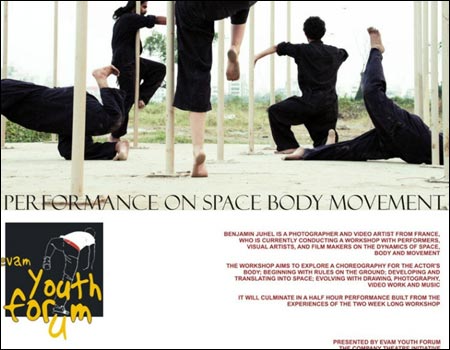
Evam Youth Forum, an initiative of The Company Theatre invited Benjamin Juhel, a photographer and video artist from France to conduct a theatre workshop, exploring the possibilities of body, space and movement. The workshop was open to actors, dancers and filmmakers. The two week long workshop culminated in a half hour performance at Tao Art Gallery on 17th November 2007�. Here Benjamin talks to Mumbai Theatre Guide about his work, of the workshop he conducted and of the presentation that emerged from it.- Deepa Punjani.
|
MTG editorial
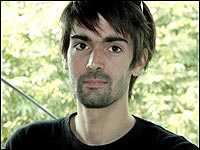
You are primarily a video artist and a photographer. How did you get interested in the theatre?
During my studies at the Ecole des Beaux Arts du Mans in France I used to create my art work with the help of different mediums like photography, video, installations, performance�but at the core I was always thinking about the idea of the body and its relationship to the others and the space it inhabits. This interest led me to meet and interact with people in performance driven art forms such as contemporary dance and theatre and even Martial Arts. Theatre interests me with its range of gestures and movement and body attitudes.
The concepts of body, space and movement take on unique dynamics with different art forms- be they painting, sculpture, photography, dance or theatre. What is your philosophy or vision in exploring the elements of space, body and movement in connection with media such as video footage?
The workshop oriented performance that you saw was not only a performance of bodies but it was also a live video and music performance. It was an outcome of the things that we created during the workshop. The interaction between
gestures, video, and sound, gives us the possibility of creating a different form of narration. It is like creating a certain mood and playing around with the mental connection between three connected and yet separate elements.
Was the performance something that you had planned or did it evolve during the course of the workshop? Was there a pre-determined theme/s for instance?
This idea of a final performance was planned, but the final presentation wasn�t.
I only proposed to the participants to create something, keeping in mind of what we had achieved together from the beginning of the workshop. The idea was: From the ground, to the space, and to the video, we will create a performance, questioning the idea of space in its original sense; with its relationship to the area, horizontally as well as vertically. We began with everyday gestures and translated those into the space we found ourselves working in. We then distanced ourselves from the original sense of those gestures. Such improvisations and other mutual exchanges and discussions aided our presentation.
What kind of activities were the participants exposed to during the workshop?
During the workshop as I�ve said, we worked with different kinds of improvisations. In the process of developing ideas, we borrowed from theater, dance and other media. Some of those improvisations were for building a kind of narration for the choreography, and others for the possibility of feeling and translating space with body movement only. We worked in different spaces. Tao Art gallery was one of the first ones. The square, the elevators, the white screen in the back� it was really an interesting space, because apart from its architecture, it was a very busy space too.
A multi-media presentation such as yours is open to a variety of interpretations. It is highly abstract. It is also demanding of its audience as multiple things are happening at one time. Do you see these aspects as challenges or do you feel it doesn�t matter as far as the audience is able to take back something- whether sensual or intellectual?
This performance was as I understand really abstract for some people. It was between theater, contemporary dance, and contemporary art ... I think. Some people came and talked with me about this performance, and this kind of theatre is perhaps not usual in India. That�s why I wanted to do it in an art gallery- a space amenable to experimentation and discussions. But nonetheless it was a challenge. The simple idea was to create a theatre oriented experience, which one could share with the audience. It wasn�t elitist or anything of that sort.
How does the element of space work if you have to present the same work in a new space?
This work will never be the same performance in another space. We�ve built a basic choreography, using cubism as a starting point. The square and some other rules are the primary elements of the play. Each new space need to be felt differently by the actors, in its own composition and architecture. The Bodies therefore will need to create a fuller dialogue with the spaces they find themselves in.
*The interviewer is Editor of this site, a theatre critic and an academic keenly interested in Theatre & Performance Studies.
|
|
|
|
|
|
| |
|