The Opera and the Gran Teatre del Liceu
The Opera
The tenth edition of the Concise Oxford Dictionary defines opera as "a dramatic work in one or more acts that is set to music for singers and instrumentalists" and of course, it is also "a building for the performance of opera." The etymology of the word can be traced back to the Latin "opus" meaning works combining solo and choral singing, declamation and dancing in a staged spectacle. The earliest work considered an opera in the currently used sense of the word dates from around 1597. It is Dafne, (now lost) written by Jacopo Peri largely under the inspiration of an elite circle of literate Florentine humanists who gathered as the "Camerata".
Opera in other words can also be deemed to be a union of drama, music and spectacle. The drama of the opera is presented using the 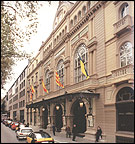 typical elements of the theatre such as scenery, costumes and acting. However the words of the opera, or the libretto are sung rather than spoken. A libretto is the body of words used in an extended musical work such as an opera, operetta, oratorio, or musical. The word libretto comes from Italian, and means "little book." The role of the libretto in the creation of a musical work varies. Some composers, notably Richard Wagner, wrote their own libretti. The works of William Shakespeare inspired many composers, including Purcell, Gounod, Verdi and Britten. Goethe's FAUST also spawned a large number of opera adaptations. Sometimes the libretto is an entirely original work, written in close collaboration with the composer, as with the libretti Hugo von Hofmannsthal wrote for Richard Strauss. typical elements of the theatre such as scenery, costumes and acting. However the words of the opera, or the libretto are sung rather than spoken. A libretto is the body of words used in an extended musical work such as an opera, operetta, oratorio, or musical. The word libretto comes from Italian, and means "little book." The role of the libretto in the creation of a musical work varies. Some composers, notably Richard Wagner, wrote their own libretti. The works of William Shakespeare inspired many composers, including Purcell, Gounod, Verdi and Britten. Goethe's FAUST also spawned a large number of opera adaptations. Sometimes the libretto is an entirely original work, written in close collaboration with the composer, as with the libretti Hugo von Hofmannsthal wrote for Richard Strauss.
The singers in an opera are thus accompanied by a musical ensemble ranging from a small instrumental ensemble to a full symphonic orchestra. Since Opera draws from other art forms, there has been a debate since the 17th century whether words or music are paramount. The visual arts, such as painting are employed to create the visual spectacle. Finally, dancing is often part of an opera performance, particularly in France. Singers and the roles they play are classified according to their vocal ranges. A particular singer's classifications change drastically over his or her lifetime, rarely reaching vocal maturity until the third decade, and sometimes not until middle age.
Male singers are classified as bass, bass-baritone, baritone, tenor and countertenor. Female singers are classified as contralto, mezzo-soprano and soprano. Each of these classifications has subcategories, such as lyric soprano, coloratura, soubrette, spinto, and dramatic soprano, which associate the singer's voice with the roles most suitable to the vocal timbre and quality and its range, or tessitura. The German Fach system is an especially organized system of classification.
Traditional opera consists of two modes of singing: recitative-the dialogue and plot-driving passages are often sung in a non-melodic style characteristic of opera, and aria-during which the movement of the plot often pauses, with the music becoming more melodic in character and the singer focusing on one topic or emotional affect. Short melodic or semi-melodic passages occurring in the midst of what is otherwise recitative are also referred to as arioso. In the late 19th century, many composers abolished much of the distinction between recitative and aria, writing opera, which is essentially presented in a restlessly melodic arioso style throughout.
No discussion on opera can be complete without some understanding of what an orchestra is. An orchestra is a musical ensemble used most 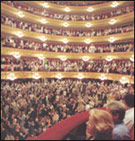 often in classical music. A small orchestra is called a chamber orchestra. A full size orchestra may sometimes be called "a symphony orchestra" or "philharmonic orchestra"; these prefixes do not indicate any difference to the instrumental content or role of the orchestra but can be used to distinguish different orchestras based in the same city (for instance, the London Symphony Orchestra and the London Philharmonic Orchestra). A typical symphony orchestra consists of four groups of musical instruments: the strings (violins, violas, cellos, double basses), the woodwinds (flutes, piccolos, oboes, cor anglais, clarinets, bass clarinets, bassoons, contrabassoons), the brass (trumpets, trombones, French horns, brass trombones, tuba), and the percussion (timpani, snare drum, bass drum, celesta, piano, etc). In modern times, the musicians are usually directed by a conductor. In fact, the most frequently performed repertoire for a symphony orchestra is Western classical music or opera. often in classical music. A small orchestra is called a chamber orchestra. A full size orchestra may sometimes be called "a symphony orchestra" or "philharmonic orchestra"; these prefixes do not indicate any difference to the instrumental content or role of the orchestra but can be used to distinguish different orchestras based in the same city (for instance, the London Symphony Orchestra and the London Philharmonic Orchestra). A typical symphony orchestra consists of four groups of musical instruments: the strings (violins, violas, cellos, double basses), the woodwinds (flutes, piccolos, oboes, cor anglais, clarinets, bass clarinets, bassoons, contrabassoons), the brass (trumpets, trombones, French horns, brass trombones, tuba), and the percussion (timpani, snare drum, bass drum, celesta, piano, etc). In modern times, the musicians are usually directed by a conductor. In fact, the most frequently performed repertoire for a symphony orchestra is Western classical music or opera.
There are many kinds of national operas today such as Italian, German, French, Spanish, Russian and others. Oriental forms of the opera such as the Beijing Opera and the Tibetan Opera are also well known. Some of the most celebrated composers in the history of the opera are Ludwig van Beethovan, Vincenzo Bellini, Georges Bizet, Benjamin Britten, Umberto Giordano, Wolfgang Amadeus Mozart, Giacomo Puccini, Richard Strauss, Giuseppe Verdi and Richard Wagner.
(The above information concerning the opera has been compiled and edited from sources such as the online "Wikipedia" encyclopedia and "OperaGlass", an online opera resource site maintained by Stanford University).
|