The Opera and the Gran Teatre del Liceu
The Performance of A MIDSUMMER NIGHT'S DREAM at the Gran Teatre del Liceu
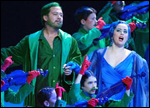 A background to the opera: A Midsummer Night's Dream (1960) is an opera by Benjamin Britten with a libretto by the composer himself and Peter Pears which adheres closely to Shakespeare's play of the same title. Thus the opera, like the play, is a comedy in which, one magical summer's night, the characters' senses are quickened and their feelings distorted and they find themselves in situations they would not have consciously wished to experience. A background to the opera: A Midsummer Night's Dream (1960) is an opera by Benjamin Britten with a libretto by the composer himself and Peter Pears which adheres closely to Shakespeare's play of the same title. Thus the opera, like the play, is a comedy in which, one magical summer's night, the characters' senses are quickened and their feelings distorted and they find themselves in situations they would not have consciously wished to experience.
Three contrasting worlds intermingle in the enchanted wood near Athens during this fleeting summer's night when the boundary between dream and reality fades and nothing is what it seems: the mysterious world of the fairies, with their queen Titania, their king Oberon, and Puck the goblin; that of the young lovers of Theseus's court, for whom true love never does run smooth; and the burlesque world of the theatre-loving tradesmen who are rehearsing a play to celebrate the betrothal of Theseus, the duke of Athens, to Hippolyta, the queen of the Amazons.
All these changes are brought about by the juice of a magic herb which causes people to fall instantly in love with the first being they see on wakening. The magic juice is spread about the wood by Oberon, who has quarrelled with Titania over her refusal to give up the little Indian boy to him: Titania falls in love with a rustic on whom Puck has fixed an ass's head and the lovers interchange their affections, growing enamoured of those they formerly shunned. When morning comes, however, everything returns to normal: Oberon makes it up with Titania and both set off for the palace in Athens to attend the betrothal ceremony, which is enlivened by the amateur actors' rendering of their ludicrous play about Pyramus and Thisbe.
Britten wrote a vibrant and highly poetic score, a veritable orchestral and vocal marvel, in which thigh-slapping comedy blends with the ethereal fairy world without undermining the musical and dramatic unity of the work.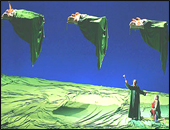 Noteworthy features include the part of Oberon -the veritable deus ex machine, who is sung by a counter-tenor and accompanied by the treble voices of the fairies and elves-, Puck's antics, and the sensual, pathetic vocal quality of Titania. The composer's subtle irony also brings us an amiable parody of Italian Romantic opera in the final performance by the ''mechanicals''. It was premiered on 11 June 1960 for the opening of the new Jubilee Hall in Aldeburgh, the small town on the Suffolk coast where Britten's Summer Festivals were held. The opera takes place in three acts. Noteworthy features include the part of Oberon -the veritable deus ex machine, who is sung by a counter-tenor and accompanied by the treble voices of the fairies and elves-, Puck's antics, and the sensual, pathetic vocal quality of Titania. The composer's subtle irony also brings us an amiable parody of Italian Romantic opera in the final performance by the ''mechanicals''. It was premiered on 11 June 1960 for the opening of the new Jubilee Hall in Aldeburgh, the small town on the Suffolk coast where Britten's Summer Festivals were held. The opera takes place in three acts.
Cast and Credits:
Musical Director- Harry Bicket.
Stage Director- Robert Carson
Set and Costume Design- Michael Levine
Choreography- Matthew Bourne
Light Design- Robert Carson and Peter Van Praet
Production- Opera de Lyon.
Orchestra- Orquestra Simf�nica del Gran Teatre del Liceu
Chorus- Escolania de Montserrat
Cast:
Oberon- David Daniels
Tytania- Ofelia Sala
Lysander- Gordon Gietz
Demetrius- William Dazeley
Hermia- Deanne Meek
Helena- Brigitte Hahn
Quince- Henry Waddington
Sung- Harold Wilson
Starveling- Andrew Foster-Williams
Flute- Christopher Gillett
Snout- Francisco Vas
Bottom- Peter Rose
Theseus- Ned Barth
Hippolyta- Jean Rigby
Puck- Emil Wolk
To say that a set of an opera, the costumes worn by the actors and the property used by them are lavish would be an understatement. An opera is undoubtedly a grand spectacle and Britten's A MIDSUMMER NIGHT'S DREAM, produced by the Opera de Lyon typifies this.
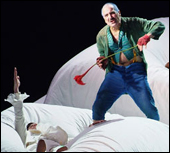 White, blue and green emerged as the dominant colours in the production, which in their turn symbolized the ethereal, mystical and the forested world of the fairies and elves. At the opening of the opera, the entire stage created an impression of a bluish luminous horizon on which a shiny white moon illumined the green costumes of the fairies and the bright electric blue gown worn by Tytania. White, blue and green emerged as the dominant colours in the production, which in their turn symbolized the ethereal, mystical and the forested world of the fairies and elves. At the opening of the opera, the entire stage created an impression of a bluish luminous horizon on which a shiny white moon illumined the green costumes of the fairies and the bright electric blue gown worn by Tytania.
The action of the play was rendered by the libretto that the actors sung and narrated in varying pitches and tones-all in tandem with the orchestra. Puck was particularly delightful and the last act in which Snug, Flute, Snout, Starveling and Bottom present their humble but instinctual drama in the Duke's court succeeded to draw in the desired laughter from the audience.
Michael Levine's set design also deserves a special mention. It captured the mood of the play well and was used imaginatively in instances such the descent of white beds with green covers on which the two pairs of lovers (Lysander, Hermia, Demetrius and Helena) sleep under the wily spell that Puck has put them under.
The actors' art in the opera is subordinated to his/her singing/narration and since music is a very important element of the opera, it must be said that an uninitiated audience may find an operatic experience strange and even difficult to comprehend. Some knowledge about the opera in terms of its context, background and music would therefore naturally help. And then it's simply a question of letting your senses take over your inhibitions, if any remain at all!
|