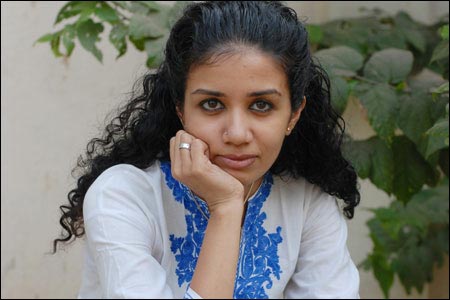
The Chennai based dancer, Preethi Athreya is trained in Bharatanatyam. While staying rooted in her classical training, Preethi has created contemporary works of dance that are compelling. She has a graduate degree in Dance Studies from the Laban Centre in London and has worked with well-known choreographer and dancer, Padmini Chettur. This June, Preethi will be in Mumbai to share her expertise with the participants of the Intensive Drama Program, which is being offered by Theatre Professionals Pvt Ltd. We ask her about what she has planned for the students and get to know a little about her own work too.
Deepa Punjani
Deepa Punjani
This is your first time as instructor at the Intensive Drama Program (IDP). What can the participants expect under your training?
I wish the IDP participants to experience a heightened sense of bodily awareness through my training. The body is indispensable to any performer, be they dancer, actor, or musician.
What are the aspects that you will be particularly stressing on in your training?
I will be working on three main aspects of space in my classes. The first is the space within the body - how to keep an active stillness. The second is the space around the body and its relation to the geometry of the performance space - to project, to create volume, tension and flow by simply becoming aware that movement is a visible aspect of space. The third is the imagined space - the means by which the world in a performer's mind begins to have a relation to the tangible world, and which is experienced by performer and spectator alike.
Theatre actors can learn a lot from trained dancers such as yourself. In our modern theatre, actors rarely take the trouble to polish their craft or upgrade their skills. They seem to exist from show to show. Dancers or musicians on the other hand are constantly rehearsing by themselves. If you were to prescribe a daily regimen for the actors to practice, what would it be?
A daily regimen for any performer is something to be crafted by the performer individually, specifically to address areas of weakness and build up areas that have potential. However, an active stretch, a low-impact sweat job and a hearty singing session (bathroom singing included) is a good beginning for an aspiring performer. One has to become friends with one's own body before attempting to win over an audience.
The kinds of performances that you and your peers do are also regarded as theatre. Contemporary dancers are known to blend various genres in their performances, and are constantly experimenting. How do you view the works you create?
The works I create do borrow elements from other genres like film, music and theatre, but my work has never been confused with theatre. It is strongly rooted in the world of dance. And like any language, dance is not a universal language. The areas of intersection with other disciplines are a play within a carefully chosen set of parameters. I sometimes view my work as the unfolding of a mechanism, with elements popping up, allowing them to be scrutinised and reassigned a new place. Every discipline has certain parameters for rigorous practice. These parameters keep shifting and changing, but they do not lose allegiance to their source. I may have some theatrical elements in my work, but they contribute primarily to the body of knowledge that is dance. What makes it interesting is the overlap onto it by other bodies of knowledge, like poetry for example.
You say that Dance is not a universal language. Can you explain it?
Dance by nature is abstract. The body is read and received differently in different cultures and contexts. For example, the act of lying face down in the ground causes a particular response in our context. The image is associated with humility or surrender often. This is not so everywhere.
Tell us a little more about the nature of your work
In my own work, I believe that all our emotional impulses are inscribed in our bodies - in the way we sit, stand and move. The dance I hope to capture each time is the ability to access this inscription. All performers hope to touch a chord deep within their spectators. It happens in different ways. In today's age, we cannot all agree on what is beautiful, what is pertinent, or what is of value. The means by which this happens is complex. It requires the creator/performer to choose their actions after much consideration of their own intention and the context in which the performance takes place.
Are you working on anything new?
I am working on a piece called 'Light Doesn't Have Arms to Carry Us'. It is the visual transcription of a piece of piano music, without the music being present. Like a silent film.
What is the biggest challenge you face in your work?
The biggest challenge I face in my work is finding and keeping the right team of people to work with. My work is very process-driven. It takes long to develop, with many dead ends and failed experiments, all as important as the final outcome. To find partners in crime to do these things is what makes the journey richer. But it's not easy to do so.