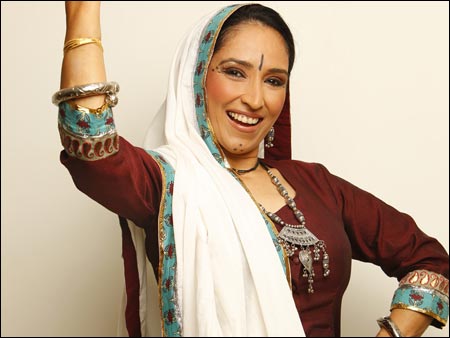
It's not that energetic cry 'Ar ra ra!' but her lively granny act in the Gujarati play AMRELI THI AMERICA that is winning over her fans these days. Ketki Dave has already staged 70 successful shows of the play all over Gujarat and now she has opened the production in Mumbai. She makes time for a free-wheeling interview, after dispatching husband Rasik and daughter Riddhi off on a US tour of home production DIKRI NO. 1.
Deepa Ranade
After your mother Sarita Joshi and you, your daughter Riddhi has made her debut on stage. How satisfying is it for you to watch your daughter make her debut?
There is a saying in Gujarati, 'mor na inda chitarva na hoye' (the essence of this saying is that it's all somewhere in the genes; a peahen's eggs are going to be a peahen's eggs). Once, my mother used to say this about me. We are glad that Riddhi has answered her calling. She is the third generation actor of the family. Where ever she goes, she is told she resembles me but she is a far more talented actor than I am.
DIKRI NO. 1 is Riddhi's first play as a full-fledged heroine, but technically she has appeared in a play with me before this. The play has already completed 230 shows all over Gujarat and Mumbai. Now they are touring across the US with it. The play highlights the daughter as the daughter-in-law. It is about how post marriage the attitude of people around a girl changes - how the same uncle becomes an overbearing father-in-law and of how the girl wins over her in-laws with her charm and practical wisdom. The play has a dose of humour, and a social message to it. People just adore the true-to-life characterizations in the play.
Your husband Rasik Dave has directed as well as acted in DIKRI NO. 1, but why did you not join the 'family' on stage?
There was no role in it for me and if I am in a play, the audience expects something special and entertaining from me. There was no such role for me in the play.
Your latest play AMRELI THI AMERICA just opened in Mumbai after its successful run all over Gujarat. What is the special appeal of the play?
AMRELI THI AMERICA is about the journey of a woman from Amreli, a small village in Gujarat to Manhattan in America. She goes visiting her grandson in the US. Though elderly, uneducated and rustic, she has a strong value system. She is also bindaas and has no qualms about speaking her mind. She is a naughty lady full of masti and humour. Eventually she wins an award from the President. People are enjoying it thoroughly because they can relate to it.
This must be an off-the-cuff performance for you considering you are so adept at playing a typical Gujju ben.
Oh, this is not the regular Gujju ben role. It was, in fact, extra challenging because I play a grandmother, a character older than my age. I had to search for gestures of an older person and then the language had to be more rustic. I had to find the character during the rehearsals. It was much more than just memorizing the lines. Even now I discover something new with every show and that is so essential for the growth of an actor. I also incorporate changes as per the feedback I get from the audience.
Do fans still ask you to do an "Ara ra ra!"?
They do expect me to say it at least once. But they know that the character in the play cannot be saying that. I don't want to confuse the viewers by bringing in Daksha ben of Kyun Ki Saas Bhi Kabhi Bahu Thi. But I must admit that the tagline has stuck by me for so many years. It is also getting popular owing to TV re-runs of the film, Aamdani Atthanni Kharcha Rupaiyya in which I have used "Ara ra ra!"
Would you say that comedy is your forte?
I started off playing a deaf and dumb girl in a Hindi play titled SANKET which we used to stage at Prithvi. Then I played a terrorist in OLLKHAYE (Identity) which was very well appreciated. HOON REEMA BAKSHI, in which I played a doctor, also went down with very well the audience. TAQDEER NO TAKAJO earned Rasik and me fame. Incidentally, all these were dramatic plays sans comedy. Then people used to wonder, "Will she be able to do comedy?" But all that changed with Daksha ben in Kyun Ki.... Originally Daksha was a negative character but I don't like to play negative characters as people don't love such characters. Since I wanted the appreciation of my audience, I gave it a comic twist and that worked wonders. So much so that at a point of time, the negativity of Daksha's character was completely lost. And now people say," Will she be able to do serious roles?" So what do I do? I just keep on working with absolute conviction and keep on learning new facets of my craft.
Did your training as an actor begin with your mother? What has been her most valuable contribution to your acting career?
Yes indeed, my training began with Sarita ji, my mother. During our vacations, my brother and I would accompany her on her tours in Gujarat and I would watch her performances daily, over and over. Initially, I aspired to be a doctor but as a teenager, I just knew I had to be an actor. I started acting on stage from a very early age, so my foundation is so strong that it will see me through this lifetime.
Sarita ji is my school of acting. She was my keen critic and she would keep pointing out my mistakes. That is how I kept on improving myself. I admire her spontaneity as an actor and her positive attitude towards life. She never mixes her professional life with her personal one. When she is on stage, she gives herself up to it completely for those three hours but when she is home she is all mom and wife.
How has Rasik Dave helped you with your career?
Rasik and I started off together; we acted in a Hindi play. I came from a theatre family background but he was the first actor from his family. We grew up together. We kept our personal and professional lives apart. We made adjustments as our children were born and were growing up.
When was your home banner Mudra launched? What are the future plans for it?
Rasik had launched Mudra in college itself; they would put up one-act plays then. Almost 30 years ago when we launched our new banner, we chose to call it Mudra again. Rasik had big ambitions and I am glad that he has fulfilled his dream about going international with Mudra. SANKET was our first production and it was a Hindi play. We have been to the USA and the UK, and all over Gujarat with Mudra. In future, we want to make tele serials and films that match our sensibility. To reach a wider audience, I would like to do productions in Hindi.
What is the current state of Gujarati theatre?
Amongst the other language theatres in Mumbai, Gujarati theatre is the best and the most prosperous. It is very vibrant and commercially successful. However, it is not at all experimental as the stakes are too high. Many shows are being staged and plenty of money is being generated on the Gujarati stage. Even lesser actors can subsist solely on acting these days. It is a golden period for Gujarati theatre.
How do you compare TV vis-a-vis Theatre as an actor?
I love TV. I got a lot from it. I used to do so much TV that I had no time left to do theatre. But now I want to strike a balance between both. There is the danger of getting saturated by playing one character in a long running tele serial. There is no growth as an actor. After completing Behenen, I took up AMRELI THI AMERICA.
After successful participation in Big Boss 2 and Jhalak Dikhla Jaa, aren't you being showered with reality show offers?
I get offered reality shows all the time. I turned down Maa Exchange, because I felt it invades one's privacy. As an actor, I can do what I please, but I cannot force my family to be a part of it. I can't expose my children to strange situations. But I enjoyed doing Big Boss because people got to know me as a person through it.
What are your non-acting interests?
I love reading, watching good English movies and just pottering around at home. At this stage of life, I want to be with myself and explore the spiritual realm.
*Deepa Ranade is a film and theatre reviewer. She has been an entertainment journalist for over fifteen years.