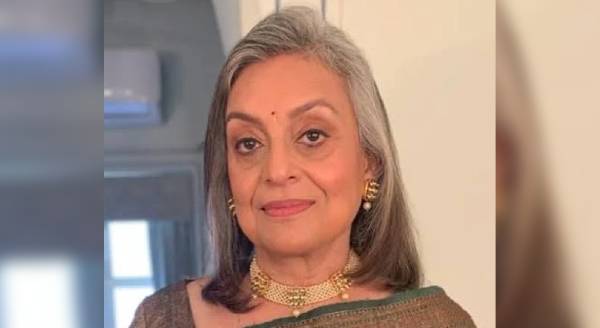
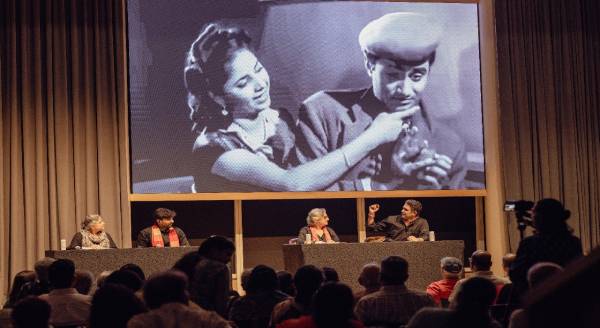
Sohaila Kapur has had a long and diverse journey in theatre. The Delhi-based director, writer, producer and playwright has been travelling with her new production, ANAND HI ANAND, about the lives and films of her three illustrious uncles--Chetan, Dev and Vijay Anand.
By Deepa Gahlot
From theatre to journalism to theatre again...so how did it start and what's been your experience so far?
I have been doing theatre since I was in high school. Four of us started the group, Ruchika Theatre, which still exists. Feisal Alkazi is running it in Delhi, everybody else has gone their way.
I was in the 10th standard and we were directing, acting in plays, and writing them also, and adapting them, and selling tickets. From there I became fond of theatre. Before that, I was a dancer. I learned from Uma Sharma's class from the age of 5 to 15, so, I've had the arts in my blood from the beginning, and my mother was the one to encourage it.
It's like, you know, when mothers can't fulfill their own desires, they do it through their children. My mother wanted to be a Manipuri dancer. She got married very early. So, she said, "My daughters will." The elder daughter is a rebel, she became an artist. So I did it. I carried on theatre through college. A bit of a break later, I came to Mumbai and I joined IPTA. I worked with the likes of MS Sathyu, I worked with Shabana, did plays with Nadira Zaheer Babbar. I did MAIN ZINDA HOON MAIN SOCHTA HOON opposite. Anupam Kher--that was a major break. Theatre has been a part of my life from very early on. Then, when I went to Canada, got married, there was a three year break. When I came back I started again. So, it's always been a part of my life.
You said in the show Anand Anand that women in the family were not allowed to get into movies but theatre was acceptable?
I had a discussion with my parents and my father said, what will you achieve with theatre, when you get married. By the time I grew up, two-income families started coming in with the wife also contributing. So he says what will you contribute to your husband? I wanted to go to NSD, he said even if you go to NSD what are you going to achieve? At that time NSD was considered the place for men who failed in their careers and women who were waiting to get married. I said, at least let me be on stage and either direct or act. So, that was harmless for them. But I don't remember them coming to see any of our productions.
The plays you did as a teenager, what kind of work attracted you?
We did a lot of very intellectual stuff like Dario Fo, Harold Pinter, Eugene O'Neil...the less mainstream and more abstract productions from France and Germany. We adapted them or we got the adaptations in English. But when I came to Mumbai, it was mainstream theatre.
When you returned from Canada, what did you start with?
There was a very strong urge in me to direct, so for some years I didn't act; I just adapted plays and directed them and then finally I wrote a play, KUCHH LIFE JAISA. I felt I wanted to write for older women, because people are normally writing about youth, relationships, romance-- there's a surfeit of it. I got fed up of seeing these romantic interludes on stage or on screen. Nobody writes about older women, especially empty nesters. What do they go through? So, I wrote this play. We had two shows which were completely full. And I had a lot of women coming to me with tears in their eyes and saying, "This is my story." So, I've written a couple of plays, and I want to continue writing mainly for older women and their lives, because I am an older woman. Their experiences never come to the fore. When you have an older woman on the screen, even now, it's either the screechy mother-in-law or it's the weepie mother. We haven't gotten out of that framework. The fact that older women have lives, they can have romance, they can have sex, they can remarry, they can divorce. All these things are there accepted but not on stage or on the screen, not in the mainstream. So I want to do it for the mainstream.
I wrote a play called O, it was a story of two women bhakts. One was Karaikal Ammaiyar from Kerala and the other Rabia, from the Middle East. So, I put one Islamic woman and one Hindu woman together and I showed their story and how despite their religion, the journeys were similar, in the sense that they battled a very masculine world. Men who didn't even allow them to become the saints that they wanted to. You know, they would say, "Why? Your place is in the home. Why are you seeking God? It's not your position to seek God." And how they struggled with society. It was a beautiful production, very experimental. People who saw it really loved it. We didn't have too many shows because after a while you need money and theatre didn't really have that kind of sponsor -- they still don't. Then another production of mine I remember is MISS JULIE, where we had the entire set made of thermocol. The other one I remember is YEH HAI MUMBAI MERI JAAN, which was the first play to blend Bollywood and theatre together. It was a spoof but I would say a very affectionate spoof. It travelled a lot and was a massive success.
In Delhi, people don't have the patience to sit beyond a certain time. I've seen the patience in Mumbai. In Delhi, there are many many youngsters' teams coming up, but they also don't go beyond one or two shows, because I think the theatre culture is not there. And there are no sponsors. You pay out of your pocket for a while.
You work with a different group now.
It's Katyayani. I have combined it with Anuradha Dar's Three Arts Club. Hers is one of the oldest theatre groups in the country, started by her father. She revived it in 2009, if I remember right, and she asked me to be a part of it. So we have been doing plays together since. She brings her actors and I bring my actors-- they come together.
What was the genesis of ANAND HI ANAND?
For a long time, I have been feeling terribly emotional about my uncles and their legacy, and I couldn't shake it off. I started seeing their old films. I thought, if I feel so strongly about it, if I want to keep watching their films, maybe I should write something about them. And then of course came this feeling that nobody has written about the three brothers together. I thought, let me write a script and see if I can do something on stage." That's how it was.
Now that you are planning to shift to Mumbai and the theatre scene in the city is very alive. What do you see yourself doing here?
First of all, I am not going to break my bond with the Delhi group. And my first initiative would be to try and get funding so they can come and perform what we already have. We have a lot of interesting plays, we've done musicals like GEETON KI MALA, GEETON KA SAFAR. Bollywood music is so popular, people sing along and they go crazy. We've had people banging on the doors after we've shut them. It happened with ANAND HI ANAND.They are heavily into nostalgia. Even the youngsters. That's a success point. And the other thing is I'm I'm also experimenting; I've got a show called KHANA AUR GAANA. I have a chef who's an excellent dancer and singer. So I thought of Abhikal, you know, that's a sensory thing--food and music. Why don't we bring these two most important things in a person's life, songs and food together? How can we do that? So then the script was written. I told him, "This is the lead and you write the script and you have to include Bollywood and Hollywood songs that have to do with food." So now he is dancing as he talks about food. It's about the history of food and film music together.
(*Deepa Gahlot is a journalist, columnist, author and curator. Some of her writings are on deepagahlot.com)