Dr Rajeev Naik is an unabashed intellectual. His scholarship in Linguistics and Art Criticism apart, his creative writing, which includes plays, are a case in point. Dr Naik is not a prolific playwright. Years ago I had watched his play SATHE CHA KAAY KARAYCHA about a couple whose life is overrun by an absent Mr Sathe that the husband keeps comparing himself to. I recall enjoying it. For one, the production directed by Sandesh Kulkarni presented an honest portrayal of an intelligent couple, both working professionals. The dialogue was engaging, witty, provocative in turn; the absent Mr Sathe became a point of reference for the couple to unravel their relationship and ways of looking at life. The couple's conversations were enhanced by a strong rapport between the two actors Amruta Subhash and Nikhil Ratnaparkhi.
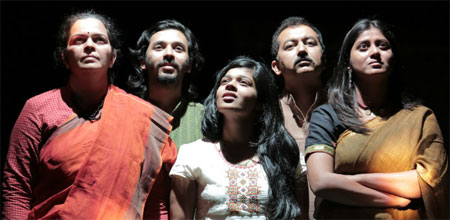
BANDISH borders on conversations too; there are more than two actors this time and the conflict is more internal, even philosophical. The characters engage in flights of memory and introspection. The pivotal figure in the group is a Professor of Physics (Kiran Yadnopavit). Presumably, his closest friend and confidante is a professional, independent and unmarried lady (Devika Daftardar). When the play opens it appears that the two have known each other a long time and have almost settled into a domestic routine. The other three characters are a young, aspiring actor (Abhay Mahajan), a young daring to go corporate woman (Sayalee Phatak) and a housewife (Gauri Lagoo). The young actor and the young woman are the Professor's proteges while the housewife strikes a bond with the Professor over books of the Swedish crime novelist Henning Mankell that the Professor lends to her.
In this unusual household, the five characters talk, eat, debate, argue, get angry, pacify and share lighter moments. The whole feel is of having descended on someone's drawing room and being privy to their conversation, their thoughts, dilemmas, complexes, inhibitions and aspirations. The Professor who mulls over the physical aspects of matter and the universe is an uneasy man on a quest for meaning; his lady friend offers him companionship and some solace but is also critical of the Professor's mental obsessions and imagined fears. The young actor from the hinterland of Maharashtra struggles with his background and lack of social status; the young girl who is economically and socially superior to the boy is trying to break free of her father's company to strike out on her own while the housewife has come to terms with her marriage that has not worked.
Dr Naik has created a canvas of real, thinking people and his women characters must be praised for the independence they seem to have achieved. The whole exercise however feels a little too indulgent at times, highlighted by the pretty stage design and meticulous attention paid to replicating a home of understated elegance and beauty, complete with designer curtains and lamps. Director Mohit Takalkar understands design and is aided by his superb team that includes the excellent light designer Pradeep Vaiddya. Mohit is discerning of the characters' backgrounds and no detail has been spared right up to their dress. Transitions between scenes are smoothly handled; the lights accentuate the scenes and it is this level of professionalism that sets groups like Aasakta Kalamanch apart. Performances by the cast are mature.
The opening piece of music Dasht-e-tanhayi mein ae jaan-e jahan by Iqbal Bano creates the desired setting but it is not soon after that the ephemeral moment is broken. In the first instance itself, we realise we are going to be in company of people not entirely free from the bickering and demands of planet Earth however advanced and progressive they may be.
Different individuals are brought together in Dr Naik's BANDISH but the composition is of fine chit-chat and not quite the raga of reflection or of journeys into the unknown. Beyond the characters' preoccupation with their own selves, the Bandish here rarely uplifts itself to create a rarefied atmosphere, or takes us into deeper realms of experience. It could be a work in progress.