I begin this article with a barrel-full of trepidation. To review a play in a language I am not fluent in is daunting. I risk it only because I am familiar with its English version and have interviewed its multi-faceted playwright. Still, it strikes me as a unique experience.
Gieve Patel's MISTER BEHRAM, an Indian-English play about a Parsi family- landowners of a fruit wadi in the Warli belt between Gujarat and Maharashtra, has been translated into Marathi by Shanta Gokhale. First staged in English in 1987 under the direction of Gieve's wife, Toni, this avatar of MISTER BEHRAM brings in a fresh ethos.
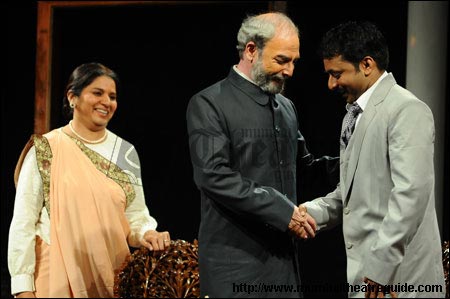
The play is set in the days of the Raj. Mister Behram (Gajanan Paranjpe) is an unusual landowner who had not only adopted and educated Nanhu, an orphaned tribal boy (Padmanabh Bind), but also gave consent to his daughter Dolly (Neelima Deshpande) to marry him.
It turns out that the father has an almost pathological obsession for the boy; love that is reciprocated by Nanhu himself. I quote from the published English text for a flavour of the poetic language:
"At sowing, planting, reaping, resting, have I not studied these bodies convinced of a mystical knowledge immured within each of them, each piece of flesh derived from the clods of earth on which they tread season after season! Our bodies are dull dough before this vision. And the colouring...generations of sunlight on that naked frame have burnished each turn of skin from wheat to bronze to a dark clotting in the folds."
Family dynamics play out against this strange backdrop - Dolly and her father competing for Nanhu's affections, with Rati (Ruta Pandit), Behram's devoted wife, struggling to assuage emotions. Only when Dolly becomes pregnant, does Behram break.
A parallel trajectory to the central storyline has political overtones. The British district collector, Mr Watts (Dilip Joglekar) wants the British to take over the neighbouring grasslands to set up an army cantonment, a move resisted by tribals. When Nanhu, a London-educated barrister thanks to his godfather, excels in court, Mister Behram, himself a celebrated barrister of the district, feels upstaged. He has no compunction humiliating Nanhu in Mr Watts' presence by asking him to strip to his native tribal loincloth, ostensibly to show off his splendid body. Nanhu complies, breaks down, and a shocked Dolly leads him away.
Love, ego, desire to humiliate, possess, subjugate are interwoven into the dark-headed tapestry of this drama, succinctly directed by Aniruddha Khutwad. I am told Shanta Gokhale's translation is completely faithful to the original but I would have liked the English retained in the scenes with Mr Watts. An Englishman speaking fluent Marathi jars and is not entirely convincing.
The director's triumph lies in the casting of Mister Behram, Nanhu and the silent, subservient servant (Vinod Vanave) whose back is always bent. Not only are the complexions of Gajanan Paranjpe and Padmanabh Bind contrasted as between fair-skinned Parsis and a tribal, they play their roles with restraint, with Padmanabh Bind holding on to dignity even while conveying deference to his father-in-law.
Beautiful carved furniture is the only distinctly Parsi touch in the play but shiny polish makes it look straight out of a showroom rather than a rustic home.
Parsi theatre has traditionally been associated with risque, low brow comedies so it is good to see Gieve Patel breaking out of this mould. "I am not interested in the Parsi as a caricature but as a person who has joys and passions like any other human being" Gieve had said in an interview at the time of MISTER BEHRAM'S English staging. "My plays are about a community but are not imprisoned in that ethos."
*Meher Pestonji is a journalist, novelist and playwright. The radio version of her play, FEEDING CROWS won the South Asia segment of the BBC/British Council Radio Playwriting Competion in 2009 and was also the international runner-up.