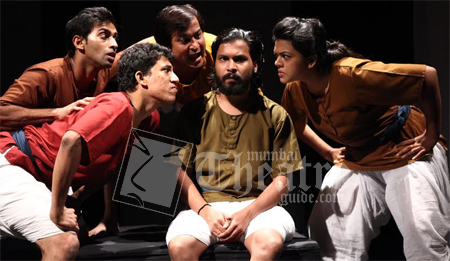
It will not be too long before the name 'Gillo' becomes synonymous with a certain kind of children's theatre in the country - sensitive, considered and elegant, that is still light on its feet, and strong on its wings. Gillo Theatre Repertory's usual fare packs in much profundity in easily digestible nuggets, but with their new play, SHE-HE-SHEY, they have come up with a work of rare maturity and an unrelenting vision that transcends the 'younger audiences' label, while still taking them along.
The play, directed by Shaili Sathyu, draws out fables from letters that Rabindranath Tagore wrote to his granddaughter, Nandini (or Poope Di), and which were compiled into the volume, Shey. Ms Sathyu uses the book's English translation, He, by Aparna Chaudhuri, as her source material, cherry-picking stories that perhaps lent themselves to be staged in striking, inventive ways within the paradigm of the minimalist theatre that her troupe specializes in (a sensibility with its own aesthetics, but also dictated by the constraints under which the group operates in a cash-strapped arts eco-system). The title reflects Gillo's signature (if literal) egalitarianism, with both male and female actors tastefully dressed in identikit kurtas and dhotis, to accommodate the fact that the cast are all alternates for the same characters, male or female.
What one is faced with, at first, is the sheer density of the material- like a wall of thoughts that cannot be broached, armored by the several tongues (in three languages, but mostly English) that now holds it. The translation creates cadences all of its own, where meanings are led astray, not of plot or circumstance or the most straightforward things, but of the deeper ideas that would perhaps have been more lucid or oral in the original Bengali, even if artlessly so. Maybe this is a matter of the actors' delivery, or it could be part of a grander design, or perhaps, more fearlessly, even the lack of one.
Given that rider, there are moments of clarity and moments of obscurity, but the opaqueness of the text is offset by visual storytelling that make the compelling vignettes take on a life of their own. Perhaps then, the only way to unlock the play's themes is through the fresh-faced countenances of a guileless ensemble full of sprightly vigor but not lacking in gravitas. It is a successful rendition, aided in large part by the movement direction by Bharatanatyam exponent Hamsa Moily, because of the feelings that brim to the surface so constantly. You can lean in to listen intently to the words, but SHE-HE-SHEY also allows you to sit back and merely soak it in, letting the gestures create the stories, pinch by pinch.
What the actors approximate, what they exude, becomes then the template of a very special kind of spectatorship. That is why the intended audience of young adults can stay on and come away with a sense of something powerful, even if it is not articulated in little accessible ways. Then of course, there are the other unguarded moments of easy humor where the flavor of performance tastes just right.
Which brings us to the tales themselves, and the crises of identity their denizens undergo - a jackal who aspires to be human, a tiger stymied by its own ferociousness, and a palm tree with its head in the clouds, with the world within its purview, yet rooted irrevocably to the earth. The lyricism on display is helped along by the soaring vocals of the cast. Whether the fables are parables is not immediately clear, their meanings not easily decipherable. Shey, the character that Tagore conjures up as his private raconteur, and Tagore himself, become Poope Di's imaginary friends, and by extension, sounding boards, that can accessed or retrieved when required, via the letters that must have always been present. It is an investment that requires the right measure of delusion and a vantage from where nothing must be seen from the prism of dry rationale, but from the carte blanche of unmitigated whimsy.
Although there is precious little to choose between the actors who inhabit SHE-HE-SHEY, all of whom are uniformly excellent, the standout is Vighnesh Sinkar who holds together, in a vice-like grip, the countless strands unraveled by this miscellany, with a laid-back, but still stringently steadfast, demeanor. While just the trope of a young girl's rites of passage wouldn't have justified this kaleidoscope of shifting emotions, that transformation is made discerningly real by Sharvari Deshpande and Hetal Varia.
Ms Deshpande, last seen in KYUN KYUN LADKI, where her disposition was decidedly melamine, transitions here to a bewitching brittleness, and gives a rich and layered sense of her character's growth. As a pivotal story is recounted, the streamers of sheer cloth in the backdrop, illuminated to reveal the visage of a white stallion, evoke grand notions of redemption, of being rescued, of flight from oppression. Whether Nandini was able to chart her own journey in the 1930s is perhaps a matter of history. The play however is an evocative, emotional send-off for those who continue to nurture the child within, even if childhood itself has been banished forever.