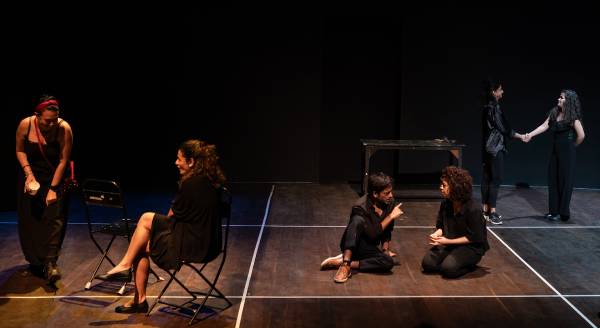
Alice Birch's ANATOMY OF A SUICIDE is a psychologically rigorous drama that deliberately shatters the conventions of linear storytelling. In Mohit Takalkar's stark and effective production, we are introduced to three women whose lives unfold not sequentially, but simultaneously on a single, shared stage. The past is not memory; it is a living, concurrent event. Dialogue from one timeline bleeds into the next, weaving a disorienting yet profound tapestry of interconnected lives.
The three protagonists-Carol (Faezeh Jalali), Anna (Amba-Suhasini Jhala), and Bonnie (Mallika Singh Hanspal)-are three generations of the same family, bound by a legacy of trauma. Their stories are not merely parallel; they are a collision. We first witness the matriarch, Carol, emerging from the sterile silence of a hospital, a survivor of a violent suicide attempt. Her life spirals into a motherhood she is unprepared for, her inner turmoil casting a long shadow that her new role cannot erase. Her unease is a palpable, foundational wound that echoes down the generations.
Simultaneously, we follow her daughter, Anna, living a life in chaotic response to her mother's instability. Anna's search for self hurtles through the haze of drug addiction, the false idealism of communal living, and a volatile marriage to a documentary filmmaker (Sukant Goel).
Finally, we see the granddaughter, Bonnie. She is the culmination of this inherited pain, a woman who has seemingly broken the cycle through professional success as a skilled physician. Yet, the legacy remains. Bonnie is intensely guarded, a fortress of controlled rigidity. Her definitive choice to remain childless is a conscious, determined act to sever the lineage, ending the cycle by refusing to pass it on.
The play's brilliance lies in this overlapping structure. By forcing the audience to witness Carol's despair, Anna's addiction, and Bonnie's clinical detachment all at once, the work makes a powerful statement: the past is never past. It is a breathing, active presence.
In Mohit Takalkar's hands, this generational trauma is made visceral by its cast. Faezeh Jallali as Carol is nothing short of heartbreaking, an immaculate portrait of bewilderment. She masterfully embodies a woman drowning in a life that, by all accounts, should make her happy, yet she is unable to connect with the husband or child she has been given. As the granddaughter, Bonnie, Mallika Singh Hanspal's performance is a study in brittle, defensive energy.
The supporting performances provide a vital anchor. Sukant Goel is compelling as Anna's husband, studying her with the cold detachment of an observer rather than a partner. Priyanka Sethia is particularly excellent, pulling double duty to essay two starkly opposite roles with remarkable precision. The entire ensemble operates with the extreme precision demanded by a script built like a mathematical formula, and their phenomenal work is the engine of the production's success.
Yet, it is the text itself that reveals a profound limitation. The play's title only hints at its scope. While it traces the lethal inheritance of a single act, Takalkar's production makes clear this story is about the crushing weight of legacy itself. The past is an active, malignant presence, and the lives of these women are presented as a single, unfolding catastrophe-a knot of pain that cannot be untangled.
This intense focus on trauma inevitably invites comparisons to the legacy of writers like Sarah Kane. But where a play like 4.48 PSYCHOSIS explodes trauma into a raw, poetic abyss, Birch's approach to the same subject is markedly different. Her writing is forensic, almost too clinically and psychologically rigorous.
This unyielding focus on inescapable destiny makes it limited. It offers a bleakly deterministic universe, one that seems to deny the human capacity for agency, resilience, or self-creation. It completely disregards the existentialist humanism of thinkers like Simone de Beauvoir, insisting that we are not merely the sum of our pasts but are defined by the futures we project.
While a philosopher like Hannah Arendt championed 'natality' - the human capacity to create new beginnings and thus break from the determined chains of the past-Birch's thoughts remain rigidly clinical. Her script is so psychologically limited that it leaves no scope for economic, social, political, or any other factors to shape a human being, reducing them to a single vector of childhood trauma. A brief encounter with a patient's family member, who challenges Bonnie's detachment and demands an apology, offers a glimpse of an alternative. This moment, however, is not enough; the play returns devoutly to psychological determinism.
Ultimately, Birch's assumptions on intergenerational trauma feel better suited for a psychology textbook than the living stage. The writing is precise, but it is the precision of a scalpel, not a poem. Despite the play winning the prestigious 2018 Susan Smith Blackburn Prize for its ambitious scope, on stage its text lacks the humane, transcendent quality-the literature-that great theatre requires. The few poetic scenes, like the recurring image of plum trees, are not enough to breathe life into a text that is otherwise so clinically constructed.
This is not to dismiss the play's profound feminist statements, which are important. However, the heavy reliance on psychological and genetic determinism strips the play of its literary and human potential. ANATOMY OF A SUICIDE is an important, meticulous viewing, but it ultimately builds boxes rather than opens paths. If one is interested in boxes-specifically, a dissection box of steel and iron words-then this is the play for them.
Dr. Omkar Bhatkar is a Sociologist and Playwright. He has been teaching Film Theory and Aesthetics and involved in theatre-making, poetry, and cinema for more than a decade now. He is the Artistic Director of Metamorphosis Theatre and Films.