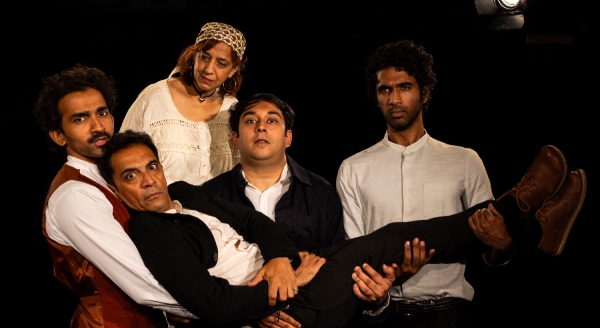
Writer : Rajiv Joseph Direction : Daniel Owen Dsouza Cast : Vrajesh Hirjee, Salone Mehta, Mathew Puthukudan, Jeh Alexander, Avirat Parekh and Keith Antony Sequeira
ARCHDUKE Review
History has recorded that the assassination of Archduke Franz Ferdinand heir to the throne of Austria-Hungary and his wife Sophie, in Sarajevo on June 28, 1914, was the trigger for World War l and the unimaginable loss of life over the following four years. The young man who carried out the killing was 19-year-old Gavrilo Princip, who accidentally walked into the path of the royal motorcade, after the botched attempt by his co-conspirators, and managed to take the shots with his pistol.
Rajiv Joseph picks on this piece of fact for his 2017 play ARCHDUKE, in which he examines how the conspiracy shaped up, leading to that fateful day. The opening of the play, produced by Hoshruba Repertory and directed by Daniel Owen Dsouza, opens with Princip (Mathew Puthukadan) and Nedeljko Cabrinovic (Avirat Parekh) having a comic Waiting for Godot kind of meeting, at a spot where they have been asked to come by a mysterious doctor. As a third man, Trifko Grabe (Jeh Alexander), joins them, it becomes clear that the three are poor, undernourished teenagers, suffering from tuberculosis—"lungers" they call themselves, as they cough up blood.
Trifko takes them to the home of Dragutin Dimitrijevic, known as "Apis" (Vrajesh Hirjee) — the eccentric head of Serbian military intelligence and mastermind of the secret organization, Black Hand. Apis recognizes that these men are the ideal terrorists, because they are already dying and have nothing to lose. It is easy to point them towards the ‘enemy’ and get them to pull the trigger of throw that bomb as the case may be.
The three are fed well by Dragutin’s cranky housekeeper Sladjana (Salone Mehta), and it just takes such a small inducement to radicalize the men. One of the greatest tragedies of the world was not caused by zealots or educated insurgents, but by the fulfillment of the men’s little desires – pudding, that Sladjana keeps offering, new clothes, leather gloves and also the belief that they have a purpose in life. Apis convinces them that their illness is caused by the suffocation caused by the Austro-Hungarian occupation, and he has readymade martyrs for Serbia.
The play with its absurdist humour, is turned into a broad farce, by making Hirjee play Apis as an energetic clown, who merrily mispronounces words.
ARCHDUKE is set in Europe of the past, but could easily be set in any country today, where unemployed, alienated youth are open to be indoctrinated into a violent cause. In the present, these men would probably be embittered incels.
With plays like GUARDA AT THE TAJ and BENGAL TIGER AT THE BAGHDAD ZOO, Rajiv Joseph takes a unique view of the past and links it to the present. Which is why, Archduke is relatable, even though it is set in a distant place at a pivotal point in European history.
The functional set and effective lighting create that sense of foreboding as the three hurtle towards their doom. D’Souza tackles the tonal shifts and broad comedy well, but then with Hirjee’s high-voltage slapstick act, it seems as if the air is sucked out of the stage when he is no longer there. Nevertheless, the play ends on a poignant note, and textbooks reveal that the boys fulfilled their destiny whether they wanted to or not; that incompetent killers did everything wrong, yet changed the course of history.
Deepa Gahlot is a journalist, columnist, author and curator. Some of her writings are on deepagahlot.com