Writer : Kalki Koechlin and Sheena Khalid Direction : Sheena Khalid Cast : Kalki Koechlin, Kettan Singh, Amba-Suhasini K. Jhala, Rachel D'Souza, Shanaya Rafaat and Shruti Vyas.
BELLY OF THE BEAST Review
There has never been a consensus over the issue of motherhood. Depending on the time, country and culture, having a baby is a blessing, or a soul-crushing burden. A child is either another mouth to feed or another hand to work. And controlling a woman's fertility often becomes a political issue - half the world is trying to induce women to have kids, the other half wants to control population; and the choice of whether to have or when is seldom left to the woman, who is the one bearing the load of pregnancy and child care. Even in a supposedly progressive country like America, abortion is a contentious issue today.
BELLY OF THE BEAST (Aadyam's third production of the season) is based on Kalki Koechlin's book, Elephant In The Womb. It is a fairly recent western or urban point of view that motherhood-at least in a nuclear family set-up-can be tough. There can be no joy in parenting if the overriding emotions are panic, anger, fear, guilt and even regret (unexpressed though it may be).
In a mother-worshipping society like ours, choosing not to have a baby after marriage is almost impossible, hence the profusion of fertility clinics. However, after the child is born, there is a fresh set of problems that have led to the drastic reduction of the female workforce. Till a few decades ago, when a majority of women were stay-at-home moms, and had a support system of relatives and ayahs, nobody spoke of postpartum depression or complained of fatigue and sleeplessness. It came as a package with the exalted status of motherhood.
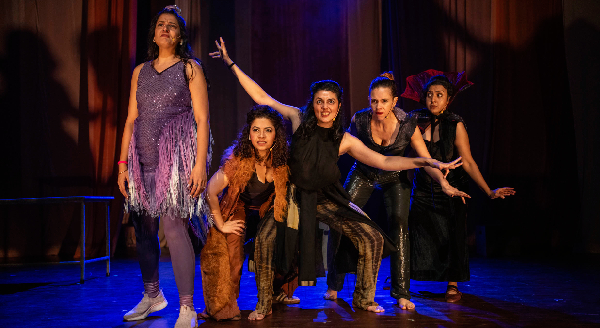
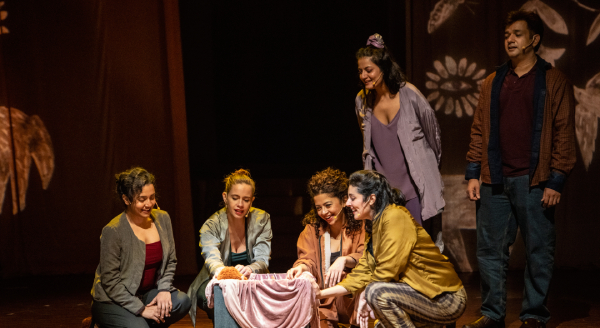
BELLY OF THE BEAST takes the sometimes humorous but mostly grim view of modern, urban motherhood, that takes a toll on women's minds, bodies, and careers- if they care about a life outside of the home. The play follows five women at different stages of motherhood, from pregnancy and labour to child rearing. The women are played by Kalki Koechlin, Amba-Suhasini K. Jhala, Rachel D'Souza, Shanaya Rafaat and Shruti Vyas, and there's a lone male, Kettan Singh, playing a doctor, boss, husband, clueless boyfriend.
Representing the various stages of motherhood are mythical creatures like a dragon, unicorn, spider, vampire and werewolf, with actors on stage projecting the shadow puppets on screens (puppetry production by Anurupa Roy and Ankit Ravani, puppet design and illustrations by Valeriya Polyancko).
As far as urban audiences go, there is a certain degree of understanding-there must be women in the audience who have lived through the experiences portrayed in the play-the fears during pregnancy, the relentless effort to balance family and career, the reduction of desire. The monologue (by Shruti Vyas) on miscarriage, in which everybody expresses their feeling of loss, when it is the woman whose body has borne the brunt, hits hard, because nobody else can fully comprehend the trauma. It is also amusing to see the loudest laughter evoked by a couple who accept that they are not monsters, "Hamare bachche rakshas hain" (our kids are demons). The problems of raising children in today's world could fuel another play!
There would be a section of audiences, who might feel that all this is perhaps a bit over the top, since for eons women have been having children-whether they want to or not- and coping with the aftermath. Kalki Koechlin is quoted in the press note, "Pregnancy is tough, birth is gruesome and postpartum is hell, but more horrifying than all three is society's completely casual approach to one of the most epic experiences life has to offer. Only when you become a mother do you awaken to the intensity and wonder of it all, to the sheer strength of character required to create life, and to transformations of mythic proportions that are unleashed upon mothers. This isn't a cute play on the gift of motherhood; this is you walking straight into the belly of the beast."
At least, the play shines a light on the subject that is simply taken for granted; and if women want to talk about it they are accused of hysteria and silenced.
(Deepa Gahlot is a journalist, columnist, author and curator. Some of her writings are on deepagahlot.com)