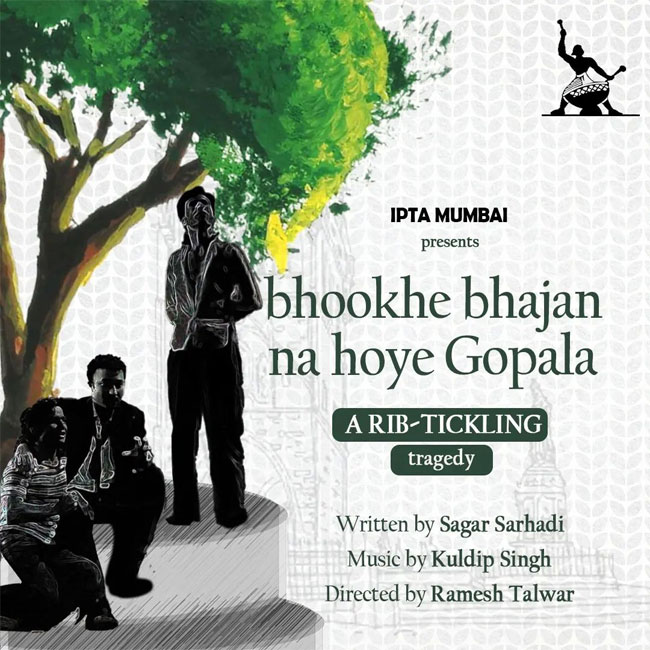
The pandemic has exposed the delicate lives of the people of the country, with scarcity being felt acutely and widely. Suddenly, we see the same India that existed before the liberalisation era. In these circumstances, BHOOKE BHAJAN NA HOYE GOPALA, written in 1966 appears just very contemporary. Laced with acerbic humour and an avalanche of ideas expressed through characters, scenes and dialogues, this play combines unending entertainment with social, economic and political commentary.
Ramesh Talwar shines in the lead role. In real life, he is a senior citizen, but in the play, he plays an energetic person whose performance cannot be bettered by an athletic teenager. He plays a person who is unable to ever get a proper meal. Aanjjan Srivastav looks apt in his role as a politician who grew up in poverty himself but is not interested in doing anything to resolve the starvation he sees in the country. There is also a character that could well have been written for Anna Hazare but the fact that this play is half a century old shows how things remain the same, the more they change. Kuldip Singh provides a brief but poignant song.
The play comments on numerous issues - unemployment, hunger, starvation, anti-people politicians, the limitations of a great protest, irresponsible media, short-sighted businessmen, inequality, gullibility of the common man, suffering farmers, and more. Apart from the commentary through dialogues, there are various scenes that have been constructed to depict situations. A key plot point is the discovery of an herb that will relieve hunger for a week. This is an actual news item that appeared in 1965 and became the starting point of the play.
The play reflects the legacy left behind by the writer Sagar Sarhadi. Sagar is the writer of films such as Silsila, Kabhie Kabhie, Noorie amongst others. His films as a producer and director have also survived the test of time and this includes the Smita Patil-starrer Bazaar. BHOOKE BHAJAN NA HOYE GOPALA illustrates his rich legacy as a playwright. The play has a satirical scene on how shocked a hungry man is when he comes to know the price of a meal at a five star hotel. Sagar Sarhadi strove to make his play free of cost or low cost for their audience. But after his death, it is slightly ironical that the ticket for his play sold at five hundred rupees each at Prithvi Theatre. The audience for this play was not the starving man whose life the play depicts.
*Tarun Agarwal is the author of Hope Factory: Business Ideas For Everyone, and has directed a short film, Honesty Weds Dishonesty