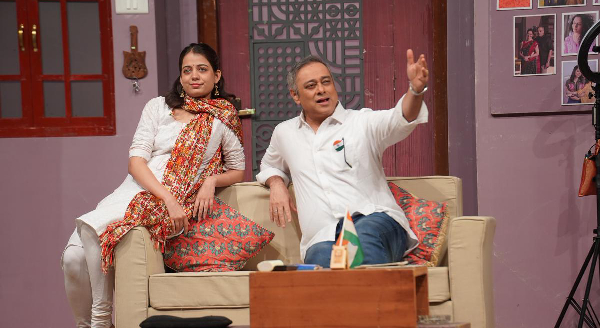
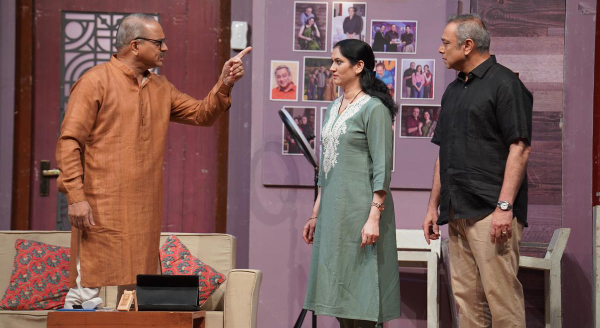
The play revolves around Vivek Jayant, a celebrated theatre and television actor who is offered the role of a towering historical personality considered to be the role of a lifetime. As Vivek dives deeper into understanding the character's ideology, mannerisms, and moral stature, the role slowly begins to consume him beyond the stage. What starts as artistic dedication gradually transforms into a psychological and emotional shift that begins affecting his relationships with his wife Ulka, daughter Kuhu, and the people around him. Through this conflict between art and personal identity, BHUMIKA explores how deeply a role can influence the actor portraying it, blurring the line between performance and reality.
One of the major highlights of BHUMIKA is Sachin Khedekar, carrying the emotional and psychological weight of Vivek Jayant. He delivers a performance rooted in restraint, intensity, and gradual transformation. His performance strengthens the play's central theme of an actor losing himself within a character. His enthusiasm as an actor gradually reflects within the character itself. Samidha Guru plays his wife Ulka, who is supportive yet strict when needed. Jaaee Khandekar appears as their daughter Kuhu, an animal rescuer with dreams and aspirations. Jayshri Jagtap as the maid and Suyash Zunjurke as the writer of the play within the play represent marginalised voices in society. Atul Mahajan plays Mama, an opinionated family member who supports the family while often engaging in debates and discussions.
The strongest aspect of this production is undoubtedly the script written by Kshitij Patwardhan. He intelligently weaves together history, social stigma, human relationships, and contemporary realities to create a narrative that feels both personal and socially relevant. The play constantly highlights the contradictions between the ideals celebrated in history and the prejudices still deeply rooted within society, exposing the visible gap between social progress and the true eradication of emotional and ideological barriers.
Chandrakant Kulkarni directs the play with an intelligent sense of realism, ensuring that not a single scene feels abrupt, forced, or unnecessary. His staging understands the emotional and ideological core of Patwardhan's writing and allows every moment to flow organically within the narrative. Interestingly, the title BHUMIKA itself carries layered meaning in Marathi, while it translates to "character" or "role," it also signifies taking a stand or expressing an opinion. The play gradually unfolds this dual meaning, making the climax emotionally and thematically impactful.
The production design of BHUMIKA complements its realism with detailed set pieces and thoughtfully used props that naturally blend into the world of the play. The lighting design makes apt use of colours to reflect the emotional mood of scenes without becoming visually excessive, while the background music remains subtle and restrained, supporting the narrative rather than overpowering it. Special attention has also been given to costumes and makeup, particularly in showcasing the passage of time through day-wise changes in the characters' appearances, along with the carefully designed costume and makeup transformation of B. R. Ambedkar, around whom the play's central conflict and thematic exploration revolve.
Beyond its surface as a family and psychological drama, BHUMIKA delves into themes of identity, ideology, and the transformative power of art. The play examines how deeply an artist can absorb a character and questions whether complete immersion into a role is a mark of artistic brilliance or a danger to personal relationships and individuality. Through Vivek Jayant's gradual transformation, the narrative reflects on human psychology, social perception, personal biases, and the fragile boundary between performance and reality.
Shashank Jadhav is a theatre practitioner, actor, writer, and director. He is the founder of Occipital Productions, under which he develops work across theatre and films.