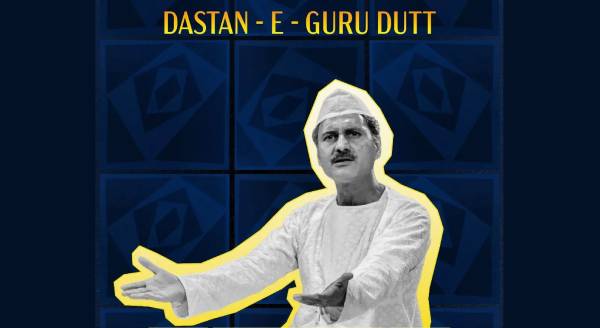
Written and Directed : Mahmood Farooqui Cast : Mahmood Farooqui
DASTAN-E-GURU DUTT Review
Dastangoi Collective is special to theatre goers as this is a celebration of Indian storytelling, an ancient art that Maqsood Farooqi revived two decades ago. A lone performer, the dastango, keeps the audience captive with his voice, gestures and narrative. This time it is an homage to Guru Dutt on his 100th birth anniversary, a director and actor who scaled the dizzy heights of popularity and then succumbed to mental misery at an early age of 39, making his real life more vivid than his reel life.
Performed by Farooqi himself, dressed in a traditional white choga pyjama and a skull cap - he takes his place on the diwan and starts off by sipping water from a metal bowl. The atmosphere is set for the story telling session. The show-- part of the Prithvi Theatre Festival--takes off effortlessly as a conversation with the audience, Farooqi highlights Guru Dutt's poverty ridden childhood in Kolkata, dance training at Uday Shankar's academy in Almora and then his struggle in Mumbai first for subsistence and then his meteoric rise in Bollywood. As the story unfolds the audience sings along Guru Dutt's evergreen hits like 'Waqt ne kiya...' and 'Yeh duniya agar mil bhi jaye to kya hai...
Language is the central character here, the dastango weaves Hindi, Urdu, English, and even Sanskrit and the narrative shapes into a lyrical linguistic centenary tribute to the creative genius and troubled master.
Farooqi navigates to Guru Dutt's professional collaborations with Dev Anand, Johnny Walker and the handsome actor Rehman who had met in Pune while working in V. Shantaram's Prabhat Film Company. He cast them together in his directorial debut, Baazi. This was a super hit, paving the way for film noir, where the hero was not morally correct. Credited to him are first like the villain in den with his moll, apart from his famous close up shots, hit music. He directed eight films and savoured success, balancing art and mart
Farooqi deals delicately while narrating the devastating portrait of Guru Dutt's romantic alliances – a tragic wedlock with singer Geeta Dutt and his romantic entanglement with his leading lady, Waheeda Rehman.
The narrator manages to balance the light and shadows of Guru Dutt's life with the same dexterity that the filmmaker was known for in his films. He brings out the gradual corrosion of the maestro into an alcoholic, swigging sleeping pills to deal with his mental demons. When the narrator recounts the commercial failure of Kaagaz Ke Phool, the performance momentarily becomes requiem—a classic that conveys the turmoil of cinema industry.
The finale of the tragic overdose that led to his untimely demise is delivered without melodrama, so it impacts the onlookers deeply. This dastan inspires you to go back and check Guru Dutt's filmography from CID, Aar Paar to Kaagaz Ke Phool. Even as the lights dim on the stage, the viewer is left with a desire to know more about this enigmatic master.
Deepa Karmalkar A senior journalist, features writer and reviewer who is now an ardent yoga saadhak.