Written and Directed : Faezah Jalali Cast : Nitya/Delzeen, Gaurika, Akhil, Pavvit, Prerana and others
EKLAVYA: THE WRONGED Review
"When you read you begin with ABC, when you discriminate you begin with OBC," says a character in Faezeh Jalali's new play EKLAVYA: THE WRONGED, that opened at Prithuvi Theatre, 2026.
Jalali had worked with the Mahabharat in her earlier production, SHIKHANDI; she returns to the epic to give the story of Eklavya, a contemporary interpretation. The epics are consumed and as an unassailable part of our culture, and the stories absorbed without question. So Elkavya, who cut off his thumb because his teacher Dronacharya demanded it as guru dakshina, is extolled as the ideal of honour and obedience, when he actually is the victim of a grave injustice.
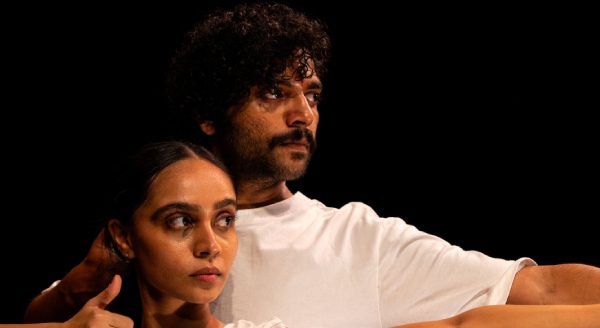
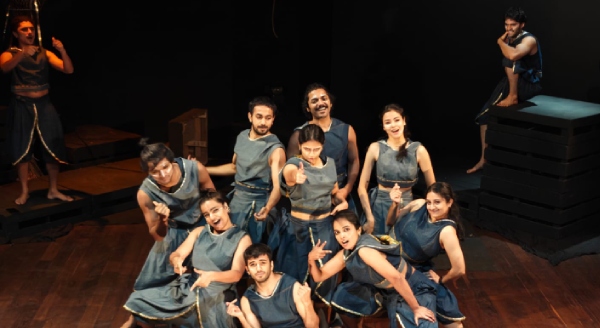
Jalali uses the high energy of her young cast, give the story a hip-hop-capoeria-kalaripayattu presentation, which must have taken a lot of practice and coordination. In a modern-day classroom, Eklayva (played by a female, Nitya/Delzeen), is berated by the teacher (Akhil) and ridiculed by fellow students, including an obnoxious Arjun (Pavvit) for being late, because his cycle broke down. In spite of being the brightest student in the class, his poverty defines him, not his talent. The only one to speak out for him, is Dushala (Gaurika), the almost unknown sister of the Kauravas, who can be as blunt as she likes, protected by the privilege of her class.
The humiliation of Eklavya in college links back to the story of the tribal boy from the Mahabharat, an expert archer, who gave Arjun a complex. Guru Dronacharya refuses to train Eklavya because he is not of noble birth. The tribals are hunters, he is told by his parents, but he wants to be a warrior. Undeterred, Eklavya builds a statue of the guru and trains himself to be such a great archer that Dronacharya and his entitled bunch of royal students are stunned. However, to protect Arjun's reputation and his royal privilege, the guru demands the sacrifice of Eklavya's thumb so that he can never shoot an arrow again.
Jalali's writing is sharp, witty, and pungent, talking of nepotism and caste/class discrimination, linking what happened to Eklavya to today's society and its endemic inequality. As much as its angry and satirical writing, the production depends on the choreography and the remarkable physical energy of the performers.
It is a show meant for Gen Z, which is now seen to be raging against the political establishment-the style, music, humor, exuberance, and cheekiness of the play is impressive. The hybrid costumes, fusion music, and mix of languages are recognizable allusions to Bollywood movies-Jalali takes a serious subject and a well-known story and turns into a lively protest, making Eklavya a hero and a symbol of the downtrodden demanding their rightful place in the social hierarchy.
Deepa Gahlot is a journalist, columnist, author and curator. Some of her writings are on deepagahlot.com