MAAI KI AAKHRI CHHATH?, written and directed by Mithil Ray and presented by Rangraahi Repertory, is a Hindi-Magahi satirical drama that uses the sacred festival of Chhath to explore caste divisions, environmental collapse, and the fading relationship between humans and nature.
Set in a drought-stricken village where the waters of the Ganga have completely disappeared, the play follows Maai's determination to perform her final Chhath Puja against impossible circumstances. What begins as a search for sacred water gradually unfolds into a layered conflict between environmental destruction, caste politics, ritualistic beliefs, and political manipulation. Through the village's moral and spiritual dilemma, the narrative sharply comments on untouchability, marginalisation, blind faith, and humanity's fractured relationship with nature while questioning what truly remains sacred in times of social and ecological collapse.
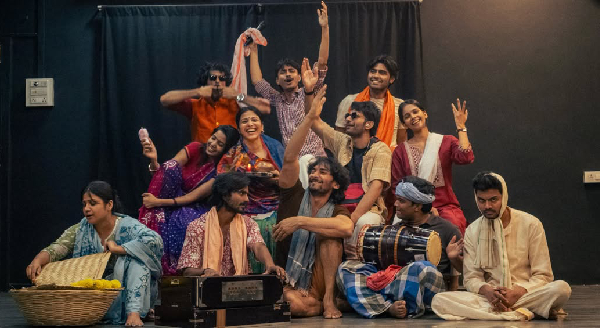
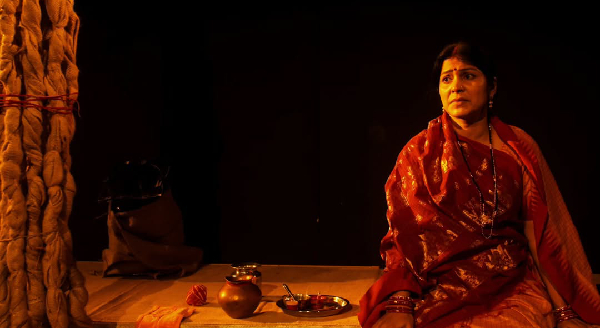
The performances remain one of the strongest aspects of the production. Maya Sharma delivers a convincing portrayal of Maai, capturing the devotion and spiritual intensity of a woman deeply committed to her faith and the sacred Chhath ritual. Mithil Ray remains an integral presence within the ensemble, while Garvit Ahuja as the son and Hemank Soni as the reporter perform effectively in their respective roles. Ananya Ghosh portrays Bimla, a young woman who treats Maai like her own mother and helps Bittu understand Maai's feelings. Swagata Bharali as the marginalised woman add further emotional and social depth to the play, while Rupesh Sharma performs suitably as the politician. Pratibha Narendra Sharma brings a lively and bubbly energy to the stage. The remaining ensemble efficiently handles multiple roles while sustaining the folk-theatrical energy of the production throughout.
The play stands firmly on the strength of its writing and direction, both of which remain clear, politically aware, and emotionally rooted throughout. The scenography is simple yet deeply symbolic, with a rope-structured tree at the centre resembling a sacred village tree, becoming both a visual and thematic anchor of the narrative. The open-stage design allows actors to remain visibly present even during transitions, reacting to ongoing scenes from the corners of the stage, which creates a living theatrical atmosphere and strengthens the audience's engagement with the performance.
Designed with the spirit of folk storytelling, the production beautifully blends contemporary performance styles with the flavour of Nautanki, giving the play an earthy and musical rhythm. The actors sing live while instruments like the bansuri and dholak organically become part of the storytelling instead of merely serving as background accompaniment. The lighting remains minimal and effective, supporting the mood without overpowering the emotional or political context of the scenes.
As the writer-director is clear about his narrative, the play moves with clarity and purpose, carrying a unified vision without unnecessary complications or narrative confusion. What begins as a ritualistic and social conflict gradually transforms into a powerful theatrical statement on environmentalism, caste realities, and the harmony between humanity, faith, and nature.
Shashank Jadhav is a theatre practitioner, actor, writer, and director. He is the founder of Occipital Productions, under which he develops work across theatre and films.