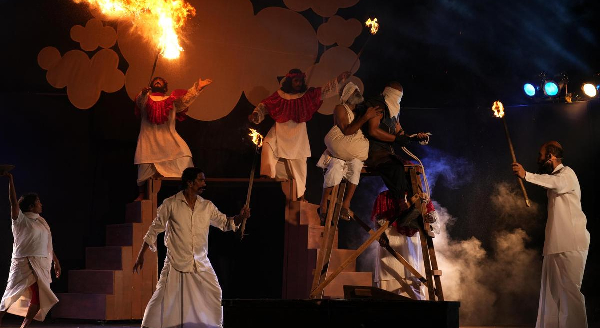
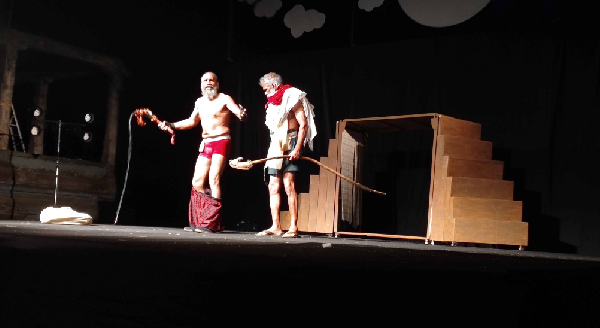
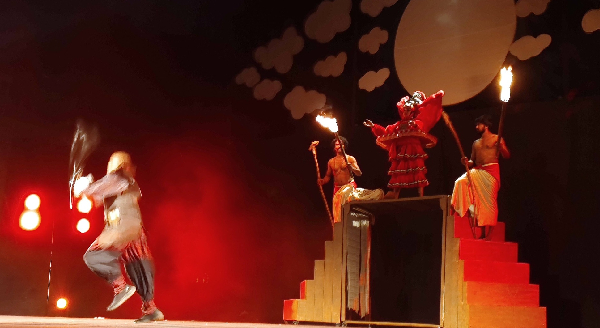
Adapting a cornerstone of world literature like Don Quixote for the stage is a formidable challenge, yet Aliyar Ali's NANMAYIL JOHN QUIXOTE meets it through a bold, localized reimagining that feels both ancient and urgently modern. This two-hour plus spectacle is a dense tapestry of Kalari, swordplay, Theyyam, and village festivals (Palliperunnal), all woven into a sophisticated structure that breathes new life into Cervantes' seventeenth-century classic.
The visual language of the production is undeniably striking, drawing clear parallels to the visceral, high-concept style of Deepan Sivaraman. There is a raw, physical intensity to the stagecraft that demands a gut-level reaction from the audience. However, Ali also maintains a rigorous fidelity to the text. While Sivaraman's work often allows the visual to deconstruct or even overshadow the narrative, here, the script remains a solid, unwavering foundation. The visuals and the text are equally glued; the spoken word is never sacrificed for the sake of the spectacle.
One notable scenographic element is the cloud-shaped screen featuring Mithun's imagery. While it provides a poetic backdrop, it ultimately feels like a secondary layer. The play is so physically and narratively robust that it could easily be staged without this digital intervention; the absence of the screen would likely make little difference to the overall impact, as the actors' bodies and the strength of the text do the heavy lifting.
This production serves as a flagship for Ali's Sportive Theatre philosophy, which treats the stage as an ankathattu—the traditional wooden arena used for Kalari duels. By demanding the physical rigor of athletes from his performers, Ali creates a unique kinesthetic energy. Yet, this athletic framing functions largely as a good practice or a magnificent embellishment. The play's intellectual and emotional weight is so profound that even if the sportive element were used sparingly or removed entirely, the dramatic power would not suffer. The Sportive Theatre enhances the rhythm, but the soul of the play resides in its thematic depth.
At the heart of the play is a radical defense of the imagination. John, the local reimagining of Alonso Quixano, is driven by a fervent mix of radical communist literature, Malayalam romantic poetry, and the original Don Quixote. He declares, "I want to create a beautiful world of equality and justice where everyone can live in harmony." The play posits a piercing counter-definition of insanity: "Lunatics are those who live ordinary lives and those who live a routine lifestyle."
In Ali's vision, real madness lies in retreating from one's dreams or succumbing to a stale normalcy. For those who remember the red era of the seventies and eighties, John is a haunting figure—a man fighting windmills in a world where revolution has been forgotten or reduced to the barrel of a gun. He refuses to believe that justice is an outdated word, even if he is the only one left fighting for it.
Ali meticulously weaves Kerala's regional history and social fabric into the narrative, transforming a Spanish story into a Malabar epic. The protagonist's journey is grounded in the Vadakkan Pattukal (Northern Ballads), the oral tradition celebrating heroic chekavas. By doing so, Ali elevates John's madness into the realm of local folklore, making his quest feel like a continuation of an ancient, heroic lineage.
The adaptation is deeply embedded in these regional aesthetics through a series of deliberate cultural transpositions that ground the narrative in the soil of Kerala. Objects of chivalry from the Spanish original are replaced by regional counterparts that carry a heavy ritualistic weight; for instance, the Knight's sword is reimagined as the curved blade of a Velichappadu, or temple oracle, while the legendary Helmet of Mambrino becomes a common aluminum vessel sold by a traveling peddler, a sight familiar to any rural village. This localization extends to the nature of the protagonist's conflicts, where the iconic battle with the wineskins is transformed into a raid on a local shop's vats of wash, the fermented liquid used for illicit liquor. Furthermore, the spiritual rebirth of the protagonists is marked by a quintessentially Malayali encounter; early in their journey, the duo meets a Theyyam performer—a ritualistic embodiment of the divine—who rechristens them "Nanmayil John Quixote" (Johne the Virtuous) and "Sancho Pachan," effectively baptizing their quest in the folk-mythic traditions of the region.
This integration extends to the legend of Cheraman Perumal, the ancient ruler who purportedly witnessed the moon split in two. John's sword is linked to this myth; a magnificent portion of the play involves Sancho Pachan's journey to straighten the sword that was bent during that celestial event. Here, the story of the King, the Goddess, and the Church all converge in one man's psyche.
The production serves as an intelligent critique of organized religion. It opens with the chilling image of a pastor deciding which books should be burned—a direct commentary on how those in power seek to censor knowledge to prevent liberation.
The play subtly invokes the spirit of Michel Foucault's work on how society deals with deviants. Under the guise of compassion and reforming those who have gone astray, religion often acts as a tool of correction and erasure. The church and the local authorities attempt to fix John by destroying his library, highlighting Foucault's observations on the institutionalization of the insane as a means of control.
John, however, transcends these boundaries through a radical sense of equality. In a landscape filled with different religions, he treats them all with the same reverence. He listens to the Goddess and the Vicar alike, standing as a direct threat to any power structure that relies on a stable, controlled mind.
Ultimately, NANMAYIL JOHN QUIXOTE is a triumph because it refuses to let its hero die in defeat. By the end, the madness is inherited by Pachan, who declares that those who give up their dreams have already tasted death. With powerful performances and unbroken humor, Ali proves that while the world may see the dreamer as a redundant manifesto or demonetized money, it is the dreamer who holds the only knowledge worth having.
Dr. Omkar Bhatkar is a Sociologist and Playwright. He has been teaching Film Theory and Aesthetics and involved in theatre-making, poetry, and cinema for more than a decade now. He is the Artistic Director of Metamorphosis Theatre and Films.