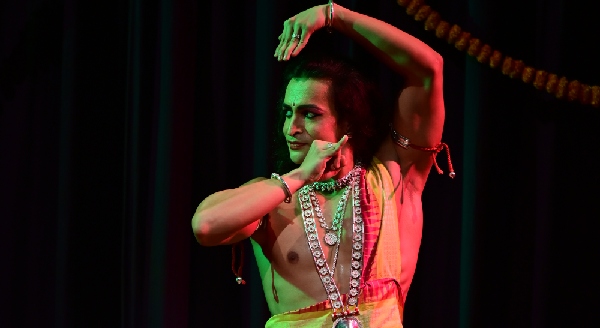
Direction : Krityea Narsingh Rana Cast : Krityea Narsingh Rana
THE LIVING SCULPTURE Review
Experiencing classical Indian dance within the close confines of Prithvi House strips away the safe distance of a conventional proscenium. Without cavernous wings to swallow an exhausted breath or forgiving stage lights to soften physical exertion, every contour of discipline is laid bare. Presented at the Prithvi Theatre Festival 2026, Krityea Narsingh Rana's solo Odissi recital, THE LIVING SCULPTURE, undertook an audacious task: to coax the carved stone of Odisha's seventh-century temples into the living, breathing present.
The result is a production of striking visual magnetism, immaculate physical architecture, and moments of transcendent kinetic poise—interspersed with dramaturgical hesitations that reveal how difficult it is to sustain the threshold between stone archetype and living human vulnerability.
From the opening invocation, the visual impact of Rana's physical presence is undeniable. His physique does not belong to the utilitarian, release-technique idiom of modern or contemporary choreography; rather, it appears directly summoned from the ancient canon of Silpa Sastra and Chola-Kalinga iconography. Draped in an ascetically pure, pristine white silk dhoti that accentuates his geometric lines, he possesses an impossibly slender waist (singha-kati) that flares into a broad, taut chest. His proportions mirror the sacred geometric ratios that 11th-century artisans chiselled into Konark and Mukteswar.
By the end of the opening piece, as physical exertion claims its toll, beads of sweat settle across his bare torso, catching the warm stage wash until his skin takes on the burnished, oiled sheen of chlorite stone kissed by temple lamps. Yet, paradoxically, this visual perfection acts as a double-edged sword. In Indian classical aesthetics, the divine form is deliberately idealized, purged of mortal blemish. At times, Rana's anatomical perfection is so unyielding that it leaves almost no room for the human element—the raw, fallible vulnerability through which an audience often finds its deepest emotional resonance. It is a spectacle of godlike containment: mesmerizing to behold, yet occasionally sealed off behind its own aesthetic impeccability.
Where this physical discipline becomes utterly electrifying, however, is in the mechanics of his gaze. Rana's mastery of ocular kinetics (drishti-bhedas) is astonishing. His eyeballs carve through space at acute, diagonal angles, shifting with razor precision from Alokita (circular glance) to Sachi (darting sidelong dart), pulling the spectator's focus across the vertical planes of his spine before settling into absolute, unwavering stillness.
Through the first four pieces, the recital commands rapt fascination. In an ecosystem where male soloists remain a relative rarity, the initial suite carries genuine novelty and kinetic freshness, elevated substantially by an exquisite musical score that anchors the auditorium in temple sonority.
The Batuka Bhairava Nritya, rooted in the 7th-century Parashurameswara Temple and codified during the 1950s Jayantika revival, serves as the evening's masterclass in Nritta. Rana deconstructs the four canonical temple instruments—the Veena, Venu (flute), Mardala (drum), and Manjira (cymbals)—with remarkable clarity. His Chowka possesses a square, subterranean weight that honors Lord Jagannath, while his transitions into the serpentine curves of Tribhanga are executed without a hint of kinetic rupture.
The aesthetic landscape shifts as Rana transitions into soft, lyrical pink silks for the third and fourth movements, mirroring the unfolding melodic textures. It is here that the musical accompaniment emerges as one of the production's crowning strengths. In the Rathyatra Pallavi (composed by Guru Srinath Attibudhi in Raga Jaunpuri and Ardha Jhampa Tala) and the subsequent exploration of the Mahari and Gotipua lineages, the acoustic tapestry—rich with the resonant depth of the mardala and crystalline flourishes of the flute—breathes alongside the dancer with exceptional tonal warmth and rhythmic subtlety. Inspired by this melodic buoyancy, Rana unpacks challenging yogic postures and classical karanas, most notably a breathtaking Natarajasana variation where he hovers suspended on a single anchored foot, gripping the raised leg behind him with sovereign stability. In these moments, the central thesis of the performance is fully realized: the stone softens, inhales, holds court, and freezes once more.
The momentum of the evening, however, hits a discernible plateau with the arrival of the fifth piece, the Ramayana Abhinaya depicting Sita's Swayamvara at Janakpur Dham. Clad in a radiant yellow Ikat dhoti drape rooted in traditional Odishan weaving, Rana executes the narrative shifts—contrasting the bluster of the failing kings against Prince Rama's effortless breaking of the Haradhanu—yet the choice of text feels tired. The Swayamvara has been staged ad infinitum across every classical Indian idiom for decades. Rendered in conventional Ragamalika and Talamalika, the episode slips into familiar, predictable mimetic territory. For a soloist whose primary strength lies in metaphysical tension and sculptured form, selecting an over-familiar episode dilutes the avant-garde premise of the concert. One longed instead for a lesser-known, psychologically fraught fragment from the epic—perhaps the quiet existential solitude of Mandodari, or Rama's solitary twilight contemplations—which would have offered richer thematic grit.
A more noticeable structural friction lies in the production's pacing and narrative bridge. The recital's seven movements are punctuated by an anchor who steps forward between pieces to offer contextual narration. While these intermissions functionally grant the soloist essential recovery time to regulate his breath and execute his stitched silk costume changes, the content and delivery of the narrative itself falter. An artist of Rana's calibre certainly warrants acknowledgement, and his professional accolades and trajectory are undeniably important. Yet, reciting a litany of earthly achievements and biographical credits in the gaps between sacred invocations inevitably dilutes the rasa. It forces an abrupt descent into the laukika—the mundane, transactional world of the individual ego—just when the stage is striving to cultivate alaukika transcendence.
Instead of reading like resume entries or pedagogical program notes, these bridge moments would serve the performance far better if the narration turned poetic, meditative, and philosophically anchored in the classical art itself. Entrusting these interludes to a seasoned actor, or weaving them into an evocative spoken-word soundscape rooted in the aesthetics of temple lore, would sustain the sacred ritual atmosphere that Rana works so rigorously to build.
The evening redeems its dramaturgical drift in the final movements, where Rana appears in a commanding, deep green silk drape framed by a bold red border, preparing the stage for cosmic invocation and final catharsis.
In the sixth piece, the Somavati Amavasya Sandhya Tandava, he delivers something truly memorable. Too often, Tandava is reduced by contemporary performers into an exhibition of hyper-aggressive, stomping theatrics (Raudra rasa). Rana's interpretation does something far more sophisticated and spiritually resonant. Rooted in the Panchakritya (the five cosmic deeds taught by Tandu to sage Bharata), this twilight dance of Shiva deconstructs aggression in favor of Anandamay (blissful), Sadbhav (pure auspiciousness), and Surakshatmak (protective sanctuary) energy.
Executing swift, soaring leaps and sovereign turns without sacrificing the rounded, lyrical spine of the Odissi grammar, Rana evokes the serene majesty of Shiva dancing at dusk to quiet the turmoil of the cosmos. It serves as a potent reminder of the classical arts' ultimate mandate: not mere virtuosic display, but the bestowal of Ananda—an unalloyed, restorative bliss that quietens the spectator's interior world.
The recital flows seamlessly from this cosmic dusk into the closing Moksha Nritya set to Pandit Bhubaneswar Mishra's iconic melodic structure in Raga Bhairavi and Ektali. Dedicated to primal Nature (Prakriti), the rapid percussive cycles dissolve the narrative ego entirely, driving forward until the final, sudden arrest on the Sam. Rana halts; the breath leaves the chest; the silhouette petrifies into darkness.
The Living Sculpture is a production of undeniable craft, musical sophistication, and aesthetic discipline. Krityea Narsingh Rana has sculpted an instrument capable of extraordinary classical fidelity, reminding us why the Kalinga friezes continue to haunt the Indian imagination. If he can infuse his thematic choices with the same daring unpredictability that defines his physical technique, and elevate stage narration from the biographical laukika into visceral poetic contemplation, this living sculpture will do more than merely dazzle the eye—it will strike straight at the marrow.
Dr. Omkar Bhatkar is an interdisciplinary artist-scholar, sociologist, and playwright. For over a decade and a half, his work has traversed theatre-making, cinema, poetry, and academic pedagogy in Film Theory and Aesthetics. He is the Artistic Director of Metamorphosis Theatre and Films