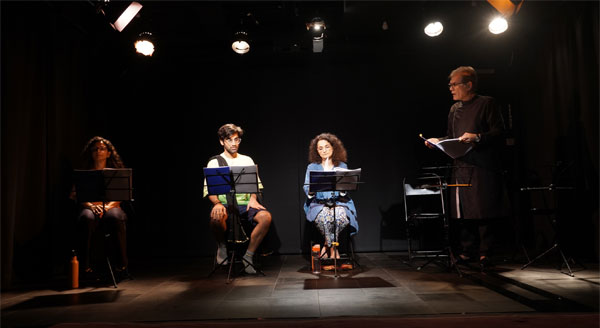
A play reading, where you forget that it is, in fact, not a full-fledged production, is when you realize how immensely immersive the performance has been. THE QUEEN, written and directed by Aditya Rawal and starring Rajeshwari Sachdev as the titular character, is one such performance.
Sachdev is magnificent as the proud but belittled Queen Durga with her perfect poise, acerbic wit, able to tear a person down in minutes with mere words, but hurting on the inside herself, ready to attack with her claws out like a wounded lioness.
Durga is married to King Amar (played by Denzil Smith), ruler of a small kingdom during the reign of Mughal Emperor Akbar. Durga used to once be young and beautiful. King Amar loved her with great passion; but with the passing years, husband and wife have drifted apart and the king has recently taken a much younger woman as his second wife. Durga now sits alone in her chamber, neglected, her pride wounded, with only her gossipy chamber maid Laila - played with wonderful levity, ease and naughty, twinkling eyes by Sharvari Deshpande - for company.
For the most part, the play takes place in Durga's chambers where one or two of the three other characters - Amar, Laila and Amar and Durga's son, Prince Veer (played by Rohit Mehra), come to meet the queen, who refuses to leave her chambers because she seems to have lost the zest for living. Preparations are on for a banquet in the palace because one of Akbar's vasal kings is paying King Amar a visit. It is a veiled threat to capitulate to the emperor or face the Mughal wrath. Amar is visiting her wing to seek Durga's counsel and help in turning the political tide in their favor. Durga's hurt has made her bitter, but her keen political thinking has not lost its edge over the years and soon, Durga agrees to help King Amar. What follows, is good period drama.
In one scene, Amar tells Durga that a spouse is like a saree: each layer that you unravel reveals more and more. That analogy seems to fit the characters of Durga and Leila too, with more layers revealed as the story progresses. The two women come from different social classes - one, a royal, the other, a poor servant girl - but both are strong and proud and know how to get their way in a society ruled by men. Durga is a bitter old queen, but also a loving mother, and like her fiery goddess namesake, ferocious and daring when the need arises. Leila means night or dark beauty in Arabic. And like her name, while the maid at first seems like just another shallow, pretty, gossipmonger, she is actually a smart woman with secrets of her own.
Amar and Veer's characters, on the contrary, are the antitheses of their names. Amar, who's name means immortal, is unwilling to act against the Mughals for fear of getting killed; Veer, meaning a courageous young man, cannot show the nerve to stand up for himself even against his own parents. And even then, they are allowed easy access to power and authority, while the smarter women characters have to fight for even the smallest amount of agency, even over their own lives. The names, themselves, are a witty piece of commentary on the society of the time.
The actors all have great chemistry with each other. Sachdev and Smith's quick transformation in tone from estranged spouses to flirtatious young lovers in flashbacks is noteworthy. Rawal's script is already full of quick repartee, but the delivery of these lines is also as perfectly timed. While the play is dialogue heavy, the lines are never unnecessarily protracted. Every jab Durga takes at her conversational adversaries reveal her own wounds a little more. Her exchange with her son Veer, somewhat reminiscent of Hamlet and Gertrude due to the Oedipal leanings of the relationship, is especially enjoyable. With everything going for it, one can only hope that this performance is produced for stage very soon.
*Neha Shende is an avid theatre-goer and enjoys watching old Bollywood movies in her free time.