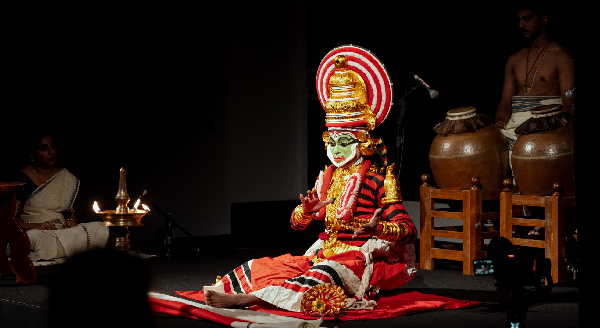
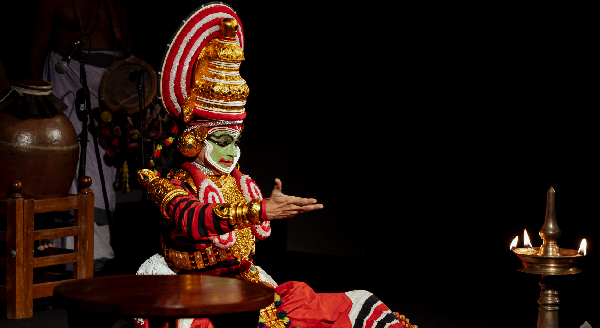
There is a moment in Bhasa's URUBHANGAM, when Duryodhana (thighs shattered, breath evaporating) looks up and sees, arranged around him like mourners at a premature funeral, everyone he has ever loved. His parents. His wife. His young son Durjaya, who does not yet understand that he is about to be anointed as king of nothing. It is possibly the most remarkable death scene in the classical repertoire of any civilisation: the so-called villain of the Mahabharata, rewritten by his oldest surviving playwright, and a father saying goodbye.
On 22 August, the Kutiyattam performance in Mumbai reaffirmed it. But to see the playwright and his playwriting shine through Kutiyattam's actor's text was most gratifying. The piece is prescient about war; it is modern about how it tells a tale and plots the play using forward and backward time shifts. I have always felt Urubhangam is about the collapse of the Kaurava empire; and the dramatic downfall of a powerful ruler but what shone through Suraj Nambiar's portrayal was the atmospheric sweep plus the gruesome details from the battlefield: The apocalypse, the bleak nihilism, and the shamshang vairagya.
It is always cathartic to see the mighty and omnipotent Duryodhana bleeding to death on the battlefield, along with his personal analysis and assessment of the situation. A revealing micro moment in URUBHANGAM is his role during Draupadi's vastraharan and how he reacts to her curse. And how in everything Duryodhana sees the eerie presence of Krishna.
The morning belonged to Prof MV Narayanan and the Kutiyattam artist Suraj Nambiar, in a lecture-demonstration organised under the banner of Nilaya Anthology, in partnership with Sarmaya and Kishima Arts. After a brief talk about the history of Kutiyattam, there was an enthralling performance of Ravana with his ten heads codified, arrogance embodied, and desire unpacked when he sights Sita. The role's virtuosity lies in staging vanity, lust, humiliation as escalating comedy: a conqueror undone by the quarrel among the ten heads.
Later, we learnt how Nambiar spends his mornings. He is up, apparently, by 4 am, and the first two or three hours of his day are given over to voice work: some twenty-three distinct voice patterns, rehearsed daily, corresponding to categories of dramatic situations that Kutiyattam has codified over centuries. Character and plot come later in this scheme. This detail about the riyaz-process tells you something about Kutiyattam that no amount of programme-note prose can: this is a tradition in which the actor's text (his stage business, breath, and gesture) carries at least as much authority as the playwright's.
This distinction is important because URUBHANGAM is, on the page, a strange, almost anti-dramatic object. Bhasa, whose classical tradition ranks so highly that Kalidasa himself is said to have felt it an honour merely to have his early play staged in a theatre that had once staged Bhasa's, breaks the oldest rule of Sanskrit dramaturgy by killing his protagonist on stage. Death was not supposed to be depicted; it was supposed to happen in the wings, reported by a messenger. Bhasa defies that convention.
Bhasa refuses the Mahabharata's own verdict on Duryodhana. In Vyasa's telling, the Kaurava prince dies cursing Krishna, unrepentant to the last, felled by a foul blow to the thigh that Bhima delivers only because Arjuna signals where to strike. Bhasa rewrites nearly every one of those facts. It is Krishna, and not Arjuna, who signals the killing blow. Duryodhana dies not cursing but reconciled, his family gathered around him, his small son's coronation arranged before his eyes; the whole scene is lit by what can only be called a subliminal, undeserved grace.
Suraj Nambiar shows us how that grace is built, moment by moment, in the body of a trained Kutiyattam performer. This is where nirvahanam, Kutiyattam's signature device, does its patient work: an actor pausing the forward motion of the plot entirely to inhabit, gesture by gesture, a character's whole interior history before a single word of the scene's actual dialogue is spoken. It is theatre that trusts its audience with unbearable slowness of being. No shortcuts, no 60 second reels.
The last few minutes of URUBHANGAM are a visual lens into the brain of Duryodhana. Suraj Nambiar humanises the great warrior and father figure as well as the family man. Every beat, every gesture, every photographic moment makes Duryodhana omnipotent. When Suraj Nambiar's Duryodhana sighs for the last time, we collectively sigh with him.
It is easy, writing about a form this old, to reach for words like "timeless." Kutiyattam resists the word. There is a certain irony in a two-thousand-year-old play about the futility of war being staged by an art form that has spent much of the last century fighting for its own survival. Kutiyattam has no box-office logic to recommend it. When the performance of Urubhangam concludes, all you remember is the death of an ancient villain who you have misunderstood. This is proof that some stories still need centuries, not seconds, to be fully felt.