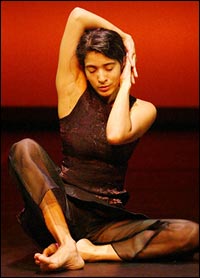
Born in 1970, Padmini Chettur is regarded as one of India's foremost dancers of contemporary dance. She began her training in the traditional dance form of Bharatanatyam and worked extensively with dancer-choreographer Chandralekha. She began her own research in 1994 and has over the years created a distinct body of work. Her recent project BEAUTIFUL THING 2 will be performed at the Singapore Arts Festival on June 4 & 5 2011.
Deepa Punjani
It's been twelve years now since your first solo work, Wings and Masks in 1999. From there on you have choreographed and performed in a number of productions that have been significant in creating your own unique brand of contemporary dance. How do you view this journey?
I'd say the journey has been equally about dance as it has been about understanding the world we inhabit. Most of all it has been about the complexity of what it means to be 'Indian' in our so-called progressive, globalised world. I think that the actual craft of making work has been part of the larger negotiation of being an artist in the particular context I operate in. Especially since my artistic instinct has constantly urged me to make choices that are not always 'popular' or easy consumable!
You spent a decade with Chandralekha performing in notable productions ranging from Lilavati and Angika to her last work Sharira. Apparently you also decided to continue as a performer after coming in touch with Chandraleka. Yet when you moved out on your own, you further sought to explore the body of the dancer in patterns that were more reduced, minimalist and distinct from Chandralekha's work. How do you describe the transition, and the points of departure?
The transition was inevitable. I see no point in repeating the work of another artist and it is only because I had specific things to research that I even began to create my own work. Right from the start my conversation with Chandra about this was very open. I suppose the most important point of departure for me has been that I don't compartmentalise as strictly as she did - the East and the West. For me this particular debate had to move beyond the post-colonial, nationalist one in order to honestly make sense of the multiple influences in my own life. I've also predominantly been working with female dancers; the work on sexuality is not part of my discourse.
One of the things that have been said to influence your thinking is your early training in organic chemistry. Can you explain that? What other influences have been significant in framing your dance ethic?
I think it's perhaps more accurate to say that there is a part of me that was attracted to organic chemistry which influences my thinking about structures and form. There have been various visual artists whose work I have followed, especially the more abstract minds from Rothko to Viswanadhan. I love the work of Escher, and the logic of anything mathematical. Being in Madras it is a privilege to live near the homes of Chandralekha and Krishnamurthy. Physically, yoga has been a daily practice.
There are critics who say that your style of dance as it is today has nothing to do with the classical form of Bharatanatyam that you are trained in. Yet there are some who have observed in your work, the essential connect of being rooted to the earth that Indian dance forms like Bharatanatyam demonstrate. What do you make of these different (and, sometimes very controversial) set of opinions? Where does the truth lie when it comes to your dance today?
Everyone is entitled to read my work as they like. It is true that in its final form - 20 years after departing from Bharatanatyam - it is difficult to recognize the clear remnants of its form. For me, and some dancers who have worked with me through this time, the connections can be made. Perhaps at this stage one can merely state that my work is also unlike other formal explorations in Western contemporary dance. For me the difficulty now is attracting dancers from the Bharatanatyam community to enter a discussion, let alone attempt the work physically. How does one construct an easy explanation out of a 20 year research? I'm still looking for these dialogues to open, and to encounter more curiosity about these processes.
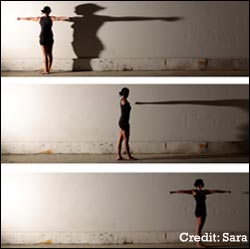
You have spoken about your need to're-look' at the body and to're-define' it. A lot of innovation in dance has been based on these very principles. But as Padmini Chettur, who comes from a certain background, training and socio-cultural context, what is it about this exercise that has framed your identity as an artiste and your idiom of dance?
I think I've been looking for the 'essential' - whatever this means. Then, if one is coming from a very stylised, 'busy' form, then the actual work is one of reduction. But when one reduces, one has to always replace what one has thrown away with something in order to make the form live again. In a way this is what I've been consistently doing. People now associate my work with 'slowness'! For me though the very action of slowing down the body has a lot more with understanding internal speed and the way this activates space.
You did BEAUTIFUL THING 1 last year, which was based on a text by Vivek Narayanan. Now you are doing BEAUTIFUL THING 2, which has been commissioned by the Singapore Arts Festival. BEAUTIFUL THING 1 has been spoken of in terms of a musical interpretation of time and space, while your latest production- BEAUTIFUL THING 2 is about memory. Artistes across genres have looked at memory as one of the key and symbolic resources to delve into. How do you see it? And, how has the expression of it come about in your work?
A friend who came to rehearsal described this work as a consolidation of everything I have worked on in the last 10 years. For me personally, since it is the first solo I've made in a long time, it has been a process of unarticulated thoughts coming together with huge clarity. I've felt a real sense of ownership and a 'stating' of form. Almost like a bringing together of all the mechanics of movement I've been researching till they actually make a first sentence.
On the one hand, contemporary dance in India has opened up. But on the other, work such as yours, still seems to receive more attention outside India than at home. Is that only because your kind of work still exists on the margins, and is not accepted by conservatives?
I think the statement itself has become a sort of cliche - the fact that I receive more attention outside India than at home. Of course, I am not programmed by conservatives and don't expect to be. However the few forums that exist in India for contemporary dance have fully embraced my work and I've never felt ignored.
You are regarded as one of the most influential contemporary dancers of your time. How do you see the future of contemporary dance in India, and what would be your piece of advice to young Indian dancers striving to seek their own?
I would say two things. The first would be to fully understand and study the work of the first choreographers to modernise dance in India/Asia. Not just their products, but also their thinking and lives. This, I think is important for the development of authentic positioning. The second would be to take time - to think about their own contribution to dance based on their research, and to not fall into the trap of churning out products to feed and already over full market.
*BEAUTIFUL THING 2 has been commissioned by the Singapore Arts Festival; co-produced by Szene Salzburg and co-presented by festival Bo:m. Tickets are available for 4 & 5 June, 8pm at $20 and $45. For more information, please visit www.singaporeartsfest.com
You can also find out more about Padmini Chettur's work by visiting www.padminichettur.com





 It's been twelve years now since your first solo work, Wings and Masks in 1999. From there on you have choreographed and performed in a number of productions that have been significant in creating your own unique brand of contemporary dance. How do you view this journey?
 You have spoken about your need to're-look' at the body and to're-define' it. A lot of innovation in dance has been based on these very principles. But as Padmini Chettur, who comes from a certain background, training and socio-cultural context, what is it about this exercise that has framed your identity as an artiste and your idiom of dance?


