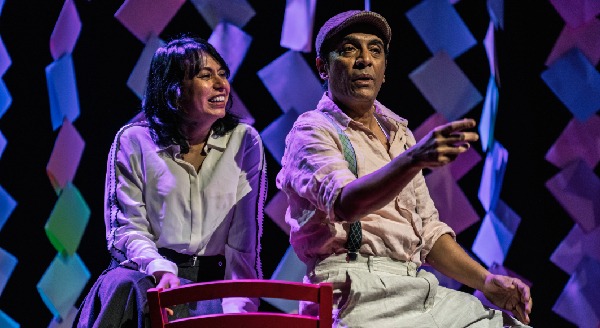
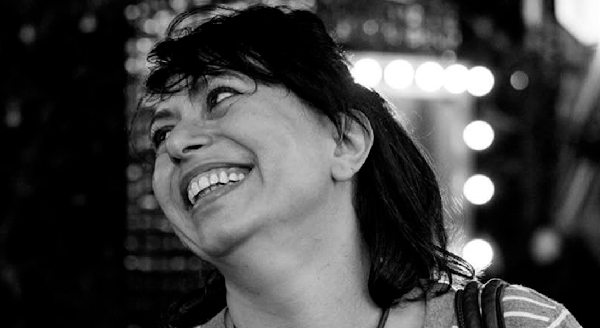
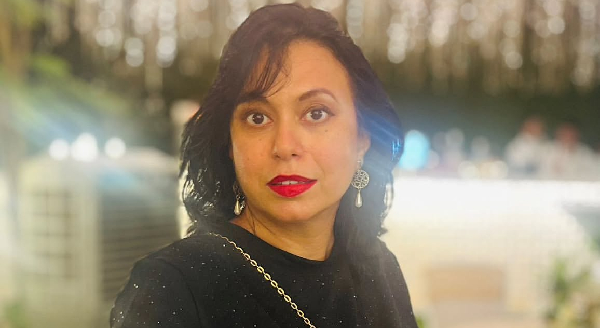
She is currently the most prolific actress on the Mumbai stage, starring in as many as eight productions, including the lead in Aadyam's DIL KA HAAL SUNE DILWALA, a delightful musical directed by Mohit Talalkar. In a career spanning over 25 years, Dilnaz Irani, engineer by training, actor by passion, has done over 50 plays in a staggering variety of roles. Her directors praise her for her discipline and professionalism, while Dilnaz, who has acted in plays with a who's who of English and Hindi theatre, wishes to work with Naseeruddin Shah.
By Deepa Gahlot
Shall we start with DIL KA HAAL SUNE DILWALA... how delightful was it to be playing a character called Asha Parekh? Yeah, it's a real thrill. I mean, of course, it's got nothing to do with the real Asha Parekh. It's just the name, but still, when we read the script for the first time, when I read the name, I was giggling.
How did you approach this character? Because the play has been adapted and relocated to Mumbai with a Bollywood set up. In his director’s note Mohit has talked about his fascination with Bollywood music… So do you also come from that space? Yes, actually I love Bollywood, I have grown up on Bollywood. I mean maybe not all these songs, I was born after some of the songs, but we heard them and grew up on them, being in Bombay. One tends to, especially now, because you know our careers are so merged whether we are doing theatre or shoots, so it kind of does have an amalgamation in a way. So, yes, I think that just makes it even more fun in that it's a Bollywood musical. Normally, I wouldn't think of anyone casting me in a Bollywood musical, so it was exciting as soon as he mentioned it.
And the play is set in the part of Mumbai where a lot of actors live—the Versova-Aram Nagar area. Basically she's from Surat. Even though it's an adaptation, there are a lot of changes. The essence is taken, but the whole larger than life Bollywood is not there in the original at all. We took a lot of time to find the character. Mohit and Chirag (Khandelwal, writer) had some ideas, plus then I came in with my own interpretation of how we want to play her. She’s a girl, like a lot of people who come to Bombay to be in Bollywood. But, honestly it's really not about that. That might be the reason she came to Mumbai, but after that it just goes on to somewhere else, there's a lot more than just a struggling actor trying to make it in Bollywood. That’s not the crux of the play.
What observations did you bring into the part? Because even though the play is not about Bollywood, it keeps coming into it because of the songs and because of the completely unrealistic way the play progresses. So what did you bring into it from your own experiences as an actor? Honestly? The feeling of rejection is something that all of us have been through. So, I think that was a very strong feeling of identification with that rejection, with someone trying to take you for a ride, because that's also what happens to her in the beginning. But then other small things also, being taken for a ride in love, then constantly looking for love and I don't just mean romantic love. I mean love for connection, love for people, to do something nice for people. I think those are all things that a little bit of me also identifies with, you know, apart from just being an actor, just trying to be a good human being and doing something good for someone else.
She was written as this Gujarati girl from Surat, but she was supposed to be neutral; I decided to change her accent a little, like give it some little flavor, because as an actor I also want to play each of my characters differently Maybe it's the greedy actor and me, but one wants to do some different physicality or have a different voice or have a different accent or something for each of the characters that that one is doing.
So, I think it was a mix of all of us trying to figure out how she would be and this is what we've come up with. So, I'm hoping it works.
It does actually. Even though she's been through the experiences of being cheated and of being let down, there is kind of innocence and a kind of hopefulness to her. The resilience also, you know, she goes on. There are people who give up, whether it's on Bollywood or love. But this girl, she keeps going. There’s a lot of me that I see in her and I've tried to put a little of Dilnaz in her as well. It was fun doing it actually, fun discovering her.
Are you a Mumbai girl? Yes…I am actually an engineer by profession. We don't come from a family of acting or theatre or anything like that. When I said I wanted to be an actor, I was told that you can't be an actor, acting is for useless people acting is for people who are not good in studies and I happen to be one of those 90% students. So, I did my engineering and also worked. But then I think finally, that whole I have one life I really want to do what I want to do and it's okay if the world it's okay if my family might not be okay with it in the beginning, but I've got to take that risk kind of happened, and yeah, then I finally left my job, and left engineering and just acted.
I started theatre with Rahul daCunha, I did I’M NOT BAJIRAO, then MERCHANT OF VENICE with Tony Patel, when I was still in my engineering days. I have written half my papers then run for a show of SIX DEGREES OF SEPARATION. I was always told that you have to manage both, and then finally I was like, I’d rather master one instead of being a jack of all kinds of things.
You started with the English theatre biggies and then moved northwards to work with a whole bunch of newer directors like Faezeh Jalali and Mohit Takalkar, who belong to a different school of theatre, so to say. So how did this journey happen and did you adapt to this? A lot of people don't know, but I was doing Hindi theatre even a while back like with Ranjit Kapoor and then with Makrand Deshpande. But people still see me as a South Bombay girl. Actually it's really strange, but my engineering helped me in that, in terms of language, because in my college no one spoke in English, so my Hindi is actually very good. I lived at Nepean Sea Road and my college was in Chembur, so I think it happened from there --the adapting to not just a language but to a different way of being me.
I haven't had any formal training as a lot of people now have had. So, it really was a matter of working with various directors and just learning something from each of them and putting it to use in the next play. I've done some 50-55 different plays so that means I work with so many different directors and that's been my training. It just gives me a change also in my head to be able to do different kinds of things.
Earlier, actors used to be attached to a particular group or a particular set of people; now the theatre scene has become more flexible. How does that work for an actor, this moving from group to group? Actually, I love that. The fact that I don't have to be stuck in one group. Someone with my personality would have space issues if I would be stuck in one group all along. I feel that really restricts you if you are working with just one or two directors. It’s interesting that now as an actor, I can go out and work with so many different directors and put it to use, you know, what I'm learning from each director is so valuable. Of course there are still egos that one has to manage, but still I feel so grateful that this is what It is now.
And one is not stuck with one group because it just opens your mind also, right? Or else you work with one group and thet one group tends to do one kind of theatre. I enjoy working with different people. So, I'll do something really, really serious with Mohit like ANATOMY OF A SUICIDE and then I will go do a Silly Point play like THE DEVIL WEARS BATA. I enjoy that as an actor, I have the flexibility to do absolutely different roles, absolutely different ways and styles of acting.
Somebody who directed you admired the way you handle your career, the focus and being on time, even if you have three rehearsals a day. I think it's become a part of me. So, if I am not on time, I'll get more stressed even though nobody else is really stressed. So, that's my personality and also it comes to the fact that I really love theatre so much that I really enjoy going to rehearsal. I feel I do it for myself, I don't do it for others, or the director or whatever. But strangely, I was speaking to my therapist about this a couple of months back. And she was like, "You made sacrifices. You just don't realize that whatever you're doing is a lot of effort, you have to accept it.” But it just comes naturally to me so I don't look at it as work.
Has it ever happened that after having done an intense play like, say,Baby Blues, that you went so deeply into a character, it has taken you time and effort to emerge from it. I think when we were BABY BLUES, I was not doing anything else, because we had shows so those two weeks I really had to focus on that. Strangely, I don't know what it was, but doing this play about postpartum depression, my menstrual cycle went for a toss. I don't know if it could be a coincidence or whatever, because after that it all became normal from the next month.
I think we don't realize that sometimes the emotional stress that we go through, because as actors we really put ourselves emotionally in that position, the stress triggers so many other things in our body. Sometimes it takes that kind of slap on your face to say, boss, come out of this before there are more health issues. I do a few exercises to get out of a character and get on to a normal Dilnaz's life.
In fact, another play that we were doing, called IRON, with Rage. Shernaz (Patel) and I were playing mother and daughter. That was also really gut wrenching, and every time we did those shows Shernaz and I used to fall sick.
Right now I'm doing eight shows. Half of them are funny and comic, the other half are serious. So, I have this whole mix and it really helps me get out of one character and get into another. A lot of people ask how do you remember lines of eight different plays and characters, and I'm like, oh it's actually very helpful.
After having done so many plays over the years, what would you consider your career highlights? I have quite a few, like my start with I’M NOT BAJIRAO. Then there is VAGINA MONOLOGUES which is still running. I was not there in the first eight years of it, but after that now I've been there since 2009. So, it's been 17 years of VAGINA MONOLOGUES. I worked with Rehan (Engineer) in two plays, and that became like a mini training for me. And then working with Faezeh, has opened my eyes to a whole different way of doing theatre, because I am not a physical actor. Even with comedy she kind of pushed it out of me, you know, the physical aspect and the comedy aspect.
So, yeah there have been a few highlights and working with Quasar (Thakore Padamsee) on PROJECT STRIP; the passion with which he feels for social causes. I think that's what I have taken from him and that's helped my choices in a lot of theatre projects that I do, theatre which is saying something more than just entertaining.
What do you think of an initiative like Aadyam? How do you think it's helping Indian theatre? I think it's great that Aadyam exists because it allows big budget productions to happen, or else as we know it's so difficult monetarily. It's just so difficult to mount a play which is in the proscenium. It's so great that there is something like an Aadyam for directors to be able to experiment with what they want to do. And also Aadyam has helped theatre reach out to the common man a little more than it used to earlier. As actors also we get a chance to do so much more theatre than we do. We get a chance to get paid a little better for theatre than an independent producer doing a play for 180 people at Prithvi would be able to pay us, right? It is great and I wish more companies would at least have theatre as their CSR. I really wish there would be more people putting in money for theatre.
Deepa Gahlot is a journalist, columnist, author and curator. Some of her writings are on deepagahlot.com