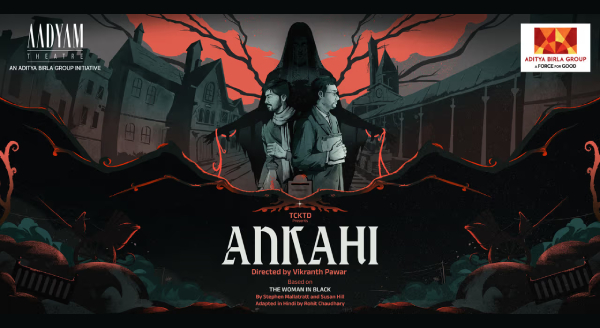
Direction : Vikranth Pawar Cast : Gopal Datt, Rohit Chaudhary
ANKAHI Review
Available technology makes it easier to portray horror on screen, but as the books of Stephen King, Dean Koontz, the original great Edgar Allen Poe and other horror writers have proved, the imagination is more powerful than the image. Words can conjure up terror, more effectively than a picture.
Which is probably why horror - though not a very popular genre on stage-is so effective, because a lot is left to the audience's imagination, and how their psychology is manipulated by the means available for performance. The physical limitations of the stage, actually work to the advantage of the production, because light and sound can convey much more fear than a scary-looking monster.
Susan Hill's 1983 novel, The Woman in Black, is a masterclass of the Gothic tradition. It is not merely a ghost story; it is a profound exploration of grief, vengeance and the tragic consequences of the inability of a rational mind to understand or accept the inexplicable. Adapted by Stephen Mallatratt in 1987, the play ran for 33 years at the Fortune Theatre in Londona's West End, making it the second longest-running non-musical play in the history of British theatre, surpassed only by The Mousetrap.
The darkly atmospheric play was skillfully converted into a lean play-within-a-play format with the large cast reduced to two, by having one actor play multiple parts. Mallatratt did that by framing the story as a theatrical rehearsal, in which an older lawyer hires a young actor to help him perform his story for an audience of family and friends. By telling them the story of his past trauma, he wants to get rid of a curse that has been plaguing him. Because he is not confident of his acting abilities, the unnamed actor suggests that he play the lawyer, while the other man takes on various small parts.
The new Hindi adaptation, Ankahi by Rohan Chaudhary, directed by Vikranth Pawar (the first production in the eighth season of Aadyam, the theatre initiative by the Aditya Birla Group), uses this format. The lawyer, Sandeepan Chauhan is played by Gopal Datt, and the actor by Chaudhary himself.
Chauhan has written a story that he claims is true, and he wants to present it to his family at Diwali time, when the telling of ghost stories is a tradition. The audience then watches the story unfold in flashback, as an enactment of the terrifying experience that Chauhan went through in the past.
He was sent from Delhi to a remote place in the Sunderbans, where he was to sort out the estate of a recently deceased client Fatima Ilyas, who lived alone for many years in an eerie wreck of a mansion. The place is reachable only by a horse drawn carriage, over a rickety bridge, that gets submerged under water when it rains.
A man he met on the train, the local contact hired for him, the clerk in the hotel where he stays for a while, the tonga driver (all played by Datt in the enactment) are cagey when asked about Ilyas House, and advise Chauhan not to stay there. But the lawyer is young, sceptical and also devoted to his work.
As the lights flicker, and the fog gets thick, Chauhan sees a forlorn-looking woman, hears the sobs of a child, the whinnying of a horse and a splash of something large falling into the river.
The light and sound design (Vikrant Thakar, Dhaval Das) brilliantly evoke the spooky atmosphere of the derelict mansion (set by Varsha Jain), with the help of projection (Abhishek Sawant). Parts of the auditorium are used for the performance, and the ghost appears anywhere in the hall, scaring some of the audience out of their skins.
While they are drawn into the story of Chauhana's hair-raising experience, the audience is also constantly reminded that they are watching a rehearsal. The actor frequently stops the action to give Chauhan comments on the performance, and they discuss the scene that is being enacted. The horse, carriage and even a dog lent to Chauhan by the train acquaintance are suggested by sound and the actions of the actors.
When the horror finally breaks through this rehearsal structure, it comes as a bigger shock, because the fiction turns out to be real. One of the most effective technical tools used is the scrim --for most of the play, the back of the stage looks like a grimy curtain, till the lights shine behind the gauze to reveal a child's room, and a creaking rocking horse.
Early in the play the actor tells the lawyer that the theatre invites its audience to create their own reality, with the props - meagre or lavish - available on stage. Ankahi draws out the fears of different people in different ways-depending on how each one responds to horror. It is not conventional 'entertainment' but with two talented actors on stage and an effective technical team, the show is gripping, even for those who may have read the book or seen earlier (smaller) productions.
(Deepa Gahlot is a journalist, columnist, author and curator. Some of her writings are on deepagahlot.com)