The past and the present- what was and what is-historical consciousness and the �present� being-the dead and the living-romantic idealism and the travesty called �life�-continuum and fracture: Welcome to the world of COLLABORATORS, a lethal combination of dark humour and an inwardly seething angst waiting to blow up all the conventions of polite society, ethical conduct and civil order. Indeed, the twenty-first century Indian dilemma is no less than a virtual time bomb. It is ticking away silently in the hearts of all those who like Kranti, the play�s protagonist, are faced with a society doing its balancing act amongst the rigors of communalism, poverty, social disparity, apathy and the rarity of �perfect procedural justice�.
Using the conventional �living-room� drama as an exit point, Playwright and Director, Ramu Ramanathan has once again marvelously succeeded in tickling the inertia of minds that may have succumbed to the routine and the supposed ordinariness of life. If his MADHEVBHAI (1842-1942) was a theatrical masterpiece to reckon with, COLLABORATORS as far as the script and the style of presentation go, has undoubtedly added a new chapter to contemporary Indian Theatre in English. The play besides being an invitee to the Berlin Literary Festival of 2005, has also won the BBC Radio writing Regional Award in 2003.
Although the centrifugal force binding this very modern and experimental production is the script, the production as a whole has a very postmodern look and character to it. This is best exemplified by the play�s set and sound design as made possible by Supriya Thyagarajan, Nikhil Khadilkar, Vinesh Iyer and Krishnan Anantha respectively. Both the play�s minimalist set and music that is at once devoid of superfluous rhythm and harmony are the perfect allies to words that speak of lost ideals, bygone dreams, tormented identities and alienation in general. While Thyagarajan, Khadilkar and Iyer�s set is quite imaginative, Anantha�s soundscape lends to the play, an almost metaphysical touch. The music, a selection of Jazz pieces mainly, thus goes very well down with the ethos of the play.
And yet, the �word� reigns supreme. The erudite playwright has once more after MADHEVBAI�created a character (Kranti) whose life will make no sense if not seen from the perspective of history. Kranti, played to almost controlled perfection by Joy Sengupta is a character that makes you weep-weep for the false sense of our security, our indifference at the larger picture of reality, our idiosyncrasies and more so for our conscious/unconscious ignorance of the past. In Kranti�s own words: �A generation is passing by. If we have to survive, - the words, phrases, languages which sustain the lie have to be disinterred. Or else, we live our lives, like collaborators� This is not indeed a happy play; there is nothing in it to give you peace. Surely living room dramas are not meant to be like this but then who says this is? Everything in it reeks of a world whose order has been broken. The other characters (Kranti�s wife and two other bridge companions) may seem to offer panaceas or moments of laughter in the face of adversity but the damage has been done. Our protagonist could not come away unscathed.
Ever so once in a while, come moments that change us and our perception of the world. This play is about one such moment. Interestingly, this moment is posed as a counterpoint to situations like playing bridge which otherwise would be normal and usual for four upper middle-class English speaking Indians. In an attempt to mock the dubious nature of all that we hold as true, the very form of the play borders on the absurd. Characters like Kranti�s wife-Arundhati (Suruchi Aulakh) and a bridge companion called Shivani (Lubna Salim) are caricaturist, sometimes to the point of embarrassment.
Moreover, the play has a sub-text that is rich with symbolism and historical cross-references that may seem overtly benign to begin with. For instance, the absent character of Mr. Mahalanobis speaks for both the past and the present state of affairs. In fact, yet another bridge companion called Himanshu (Satyajit Sharma), ever so often through his rich and baritone voice, conveys the underlying references as the very word, �Collaborators� assumes multiple meanings. In any case, the word has both a positive and a negative connotation that the playwright has exploited to the optimum in the narrative.
At one level, the play in its complete breakaway from realism may be described as complex and yet the narrative, which moves between the past and the present, is evocative enough to keep one glued. Sure, this is no �A for Apple� stuff but then kudos to the man and his team who have had the courage to move beyond the obvious towards a product that can at once be deemed a piece of good literature as well as theatre.





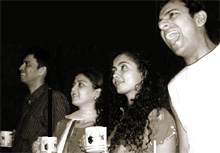 Using the conventional �living-room� drama as an exit point, Playwright and Director, Ramu Ramanathan has once again marvelously succeeded in tickling the inertia of minds that may have succumbed to the routine and the supposed ordinariness of life. If his MADHEVBHAI (1842-1942) was a theatrical masterpiece to reckon with, COLLABORATORS as far as the script and the style of presentation go, has undoubtedly added a new chapter to contemporary Indian Theatre in English. The play besides being an invitee to the Berlin Literary Festival of 2005, has also won the BBC Radio writing Regional Award in 2003.


