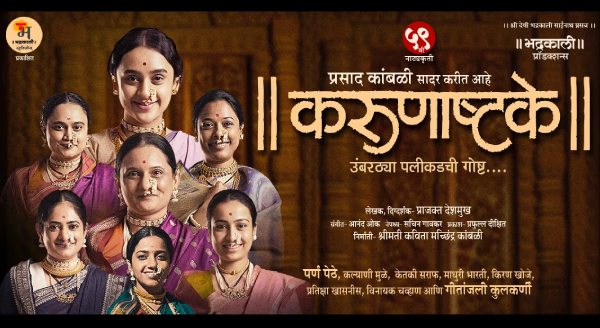
Written and Directed : Prajakt Deshmukh Cast : Geetanjali Kulkarni, Parna Pethe, Kalyani Mule, Kiran Khoje, Vinayak Chavan, Ketki Saraf, Madhuri Bharti and Pratiksha Khasnis.
KARUNASHATAKE Review
Prajakt Deshmukh's KARUNASHTAKE is a powerful contemporary Marathi play that plunges its audience into the suffocating, orthodox confines of late 19th-century Nashik. Though the story is fictitious, it serves as an unflinching look at womanhood, widowhood, and the profound silences imposed upon both. The play argues for the transformative power of endurance, proposing that grief, once given language, becomes a tool of quiet resistance. However, this transformation is not inherent; it is a spark ignited. The play's world, a home for widows, is a fiefdom starkly managed by the formidable Bai, played by Geetanjali Kulkarni. The embers of rebellion only begin to glow with the arrival of the defiant central character (Parna Pethe). Where Bai rules with a 'legacy of unkindness,' Pethe's character acts as a potent catalyst, introducing a disruptive spirit of inquiry that compels the other widows to finally question the terms of their bleak existence.
The play's core conflict is a collision between Bai's entrenched, orthodox conservatism and a nascent, challenging idea of womanhood. This ideological schism is captured in devastatingly effective dialogues. Bai poignantly remarks, "Bai ni asa dharma karava ki pudhe baichya janmala nahi ale pahije" (A woman should follow dharma so that she doesn't have to be born a woman again). In sharp, feminist contrast, Parna's character later demands to know why dharma cannot be made in such a way that a woman would be happy to be born as one.
This tension between rigid tradition and emergent modernity is crystallized in another powerful exchange. When Bai finds the distant sound of a new train 'demonic,' Parna's character cleverly counters: the sound of temple bells also travels far, so are they demonic too? The play also deftly widens its lens, acknowledging that lower-caste women, while facing their own distinct set of problems, are not subject to these specific orthodox atrocities. It's a nuanced observation that highlights the complex intersectionality of caste, class, and gender.
This entire web of social and ideological conflict is anchored by a set of truly riveting performances. Geetanjali Kulkarni, in her celebrated return to the stage, is unforgettable as Bai. She crafts a figure of terrifying, unyielding authority, where every clipped cadence of her voice and each penetrating stare asserts her control. She embodies the rigid past. As the catalyst for change, Parna Pethe is a perfect foil, embodying the central role with a compelling paradox of fragility and inner fire. The ensemble is equally formidable, with Kiran Khoje delivering a potent, deeply felt performance and Vinayak Chavan shining with a quiet, resonant humanity.
Written and directed by Prajakt Deshmukh, KARUNASHTAKE blends abhangas of Sant Ramdas, memory, and music to give voice to women who dared to feel, remember, and endure. The production reunites the successful trio from SANGEET DEVBHABLI: Deshmukh himself, alongside lighting designer Prafulla Dixit and music composer Anand Oak. However, the retreat from SANGEET DEVBHABLI'S aesthetic brilliance is stark. Sachin Gaonkar's set is a purely traditional Marathi theatre framework, and Prafulla Dixit's lighting is merely functional. The entire visual approach feels safe, unadventurous, and staid.
As a feminist work, the play is potent, though it grapples with the "two steps forward, one step backward" ambivalence common to feminist struggles in India. The ending's plot resolution may feel somewhat perfunctory, but this is largely redeemed by its powerful final line: 'Chalayla laglo ki vat apopap sapdate' (once we start walking, we find the path). This sentiment provides a resonant, hopeful conclusion, even if the narrative journey to reach it feels slightly rushed.
Nonetheless, KARUNASHTAKE, staged by Bhadrakali Productions, is a significant and soulful piece of theatre. It successfully explores the space "beyond the threshold"â€"where tradition meets rebellion and silence finds its song. For enthusiasts, it offers a vital glimpse into the continuing evolution of Marathi theatre, championing powerful dialogues, actor-driven storytelling and women-centric narratives that resonate deeply.
Dr. Omkar Bhatkar is a Sociologist and Playwright. He has been teaching Film Theory and Aesthetics and involved in theatre-making, poetry, and cinema for more than a decade now. He is the Artistic Director of Metamorphosis Theatre and Films.