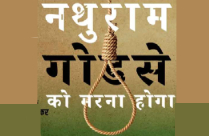
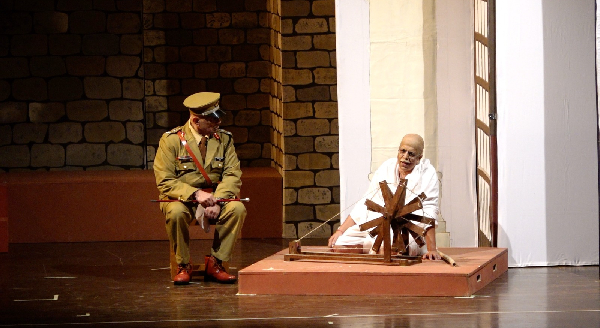
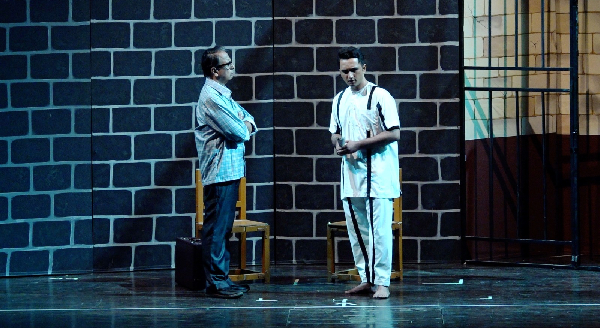
NATHURAM GODSE KO MARNA HOGA, adapted and directed by Bharat Dabholkar and presented by Paritosh Painter, is a Hindi adaptation that draws loose inspiration from the controversial Marathi play Mi Nathuram Godse Boltoy. Produced by Sejal Dipak Painter, the play features Vikas Patil as Godse and Anant Mahadevan as Gandhi, alongside Mohan Azad and Bharat Dabholkar, with narration by Deepa Bhajekar.
The production claims to offer a balanced and factual perspective through references to historical records and opposing viewpoints. However, beyond these assertions, the play sets up an expectation of ideological engagement rather than a clearly defined dramatic narrative, framing itself more as a perspective-driven exploration than a conventional plot-led performance.
The title feels misleading, as the play never really addresses why Nathuram Godse has to die. Instead, it leans toward justifying why Gandhi was assassinated, which comes across as disturbing. Although the makers mention at the beginning that the language has been softened due to past controversies, the underlying stance still feels strongly opinionated. The idea presented in the play "actions speak louder than words" feels contradictory given the extensive verbal justification that follows.
Ignoring the narrative, the play lacks a strong spine plotwise. It largely comes across as jingoism towards the assassin with a list of complaints against Gandhi, reading more like justification than any sense of guilt or balanced exploration. Artistically too, it feels under-directed, almost like a staged reading with movements and over-explanation of a historically wrongful act of violence.
The play offers limited concrete evidence to support its claims, relying largely on selective references such as writings by Godse's brother, which makes the argument feel one-sided rather than thoroughly examined. Audience reactions, especially applause at certain dialogues, reflect how sensitive and unresolved the subject still is. The play raises ethical discomfort in how violence is discussed, where the act of taking a life risks being rationalised. It brings up a larger concern that justice cannot be left to individual belief or preconceptions, particularly when it involves an unarmed figure like Gandhi, and the continued support for such perspectives remains unsettling.
Narrative-driven productions often tend to find evidence for their preconceived notions. So, watch only if you have a strong grounding in history and the ability to separate ideology from justification. The subject is highly sensitive and can be misread, potentially fuelling polarised thinking and normalising violence in the name of belief systems. Not suitable for viewers prone to extremist interpretation or rigid ideological reactions, where historical events may be wrongly used to validate present-day aggression.
Shashank Jadhav is a theatre practitioner, actor, writer, and director. He is the founder of Occipital Productions, under which he develops work across theatre and films.