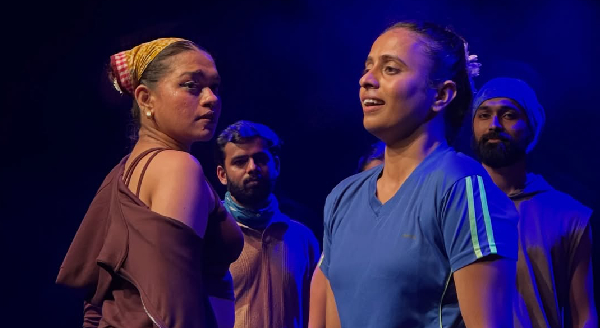
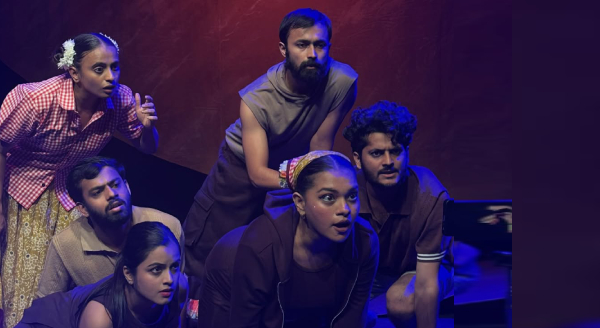
OTTAM - Born to Run, written and directed by Sapan Saran and produced by Tamaasha Theatre, is a powerful theatrical exploration of gender, caste and identity through the journey of athlete Akai Amaran.
The play follows Akai, the daughter of a Parai maker from rural Tamil Nadu, whose desire to outrun the limitations of caste and tradition slowly transforms her into a rising athlete. What begins as a journey of speed and ambition gradually unfolds into a layered exploration of identity, gender politics and the scrutiny faced by women in competitive sports. Through references to pioneers like Kathrine Switzer, the first woman to officially run the Boston Marathon despite attempts to stop her from doing so, the narrative draws parallels between historical exclusion and contemporary gender politics. What begins as a sports drama gradually transforms into a broader conversation about identity, biology and dignity.
Shweta Mishra delivers an outstanding performance as Akai, carrying the emotional and physical demands of the play. Janhvi, as Akai's alter ego, repeatedly grabs attention with her powerful live vocals. Prabhakar Mathapati brings equal depth to two contrasting roles, Akai's father in the first half and the academy coach in the second. His dialogue as coach, "Race mein koi ladka ladki nahi hota, bhaagne ke liye sirf do pair lagte hai." remains one of the most memorable lines of the play. Deepali Badekar convincingly differentiates between the characters of Akai's mother and teacher, while Chetna Dhyani, Aayush Thakur, Dipika Pandey, Shashank Pallav and Sushama Deshpande contribute strongly towards maintaining the energy and movement-driven rhythm of the production.
Sapan Saran's writing and direction are visually dynamic and aesthetic throughout. The first half strongly roots itself in caste realities and inherited labour, while the second half gradually shifts its focus towards gender identity and the politics of sports. One of the strongest directorial achievements lies in the physical staging of running itself. The actors appear perfectly trained, making the running sequences feel natural rather than choreographed. The use of the biographer as a narrative device also adds an interesting layer.
The live singing, combined with recorded tracks and on-stage percussion and Parai performances, creates an immersive theatrical experience. The Parai and folk movement training by Adarasu adds authenticity to the production. The lighting design smoothly transitions between memory and psychological conflict. The abstract set design, dominated by a sun-like structure and a pathway resembling both a racing track and a road towards the sky, beautifully reflects the themes of identity, struggle and aspiration.
The play does not merely discuss caste, gender or sport as separate issues, but connects them through the body of one individual constantly being observed, judged and questioned. The play also attempts to explore Olympism as a philosophy of life rooted in dignity, equality and the celebration of human potential beyond social divisions. With strong performances, compelling stagecraft and a fearless thematic core, the production emerges as an eye-opening and emotionally charged theatrical experience. It is undoubtedly among the most recommended plays currently on stage for audiences looking for meaningful and powerful theatre.
Shashank Jadhav is a theatre practitioner, actor, writer, and director. He is the founder of Occipital Productions, under which he develops work across theatre and films.