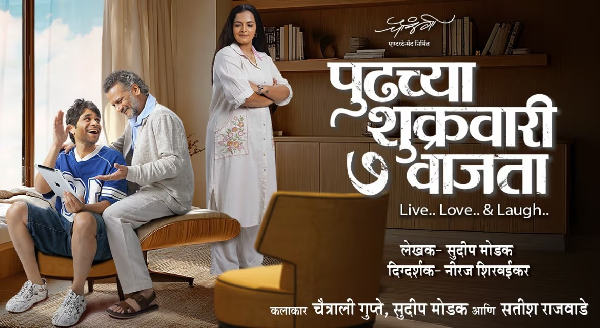
Set against the backdrop of urban struggle and psychological conflict, the story follows Radhika, an ambitious corporate professional who reaches out to her old friend Dr. Atul, a drug therapist with strong ethics and morals, and deep social commitment, in an attempt to help Mangesh Gaikwad, a hacker and a slum boy battling drug addiction.
What begins as a therapeutic intervention slowly unfolds into an exploration of transformation, dependency, and shifting human equations between the three central characters.
The writing stands out as the strongest pillar of the play, shaping its narrative and emotional depth. The title Pudhchya Shukrawari Saat Vajta is well integrated into the structure, centring around the weekly meetings between patient and doctor at 7 pm every Friday. Director Neeraj Shirvaikar enhances the writing through sharp visual storytelling and innovative stagecraft. The most striking element is the set design, which physically transforms on stage by splitting it in half and rotating 90 degrees to reveal different locations. Despite a few stretched and slightly repetitive patches, the direction maintains control over the narrative flow, ensuring the play never loses its grip on the audience.
Satish Rajwade brings quiet authenticity and restraint, adding depth through his natural and charismatic stage presence. Chaitrali Gupte complements the dynamic with a grounded, sensitive performance without overstatement. Sudeep Modak brings a dual-layered performance as writer and actor, balancing the rawness of a slum boy battling addiction with a subtle intellectual undertone.
The lighting design contributes well to the narrative, especially in distinguishing hallucination sequences through distinct visual tones, with spotlights used to represent the patient's imagined friends and characters when the stage is otherwise empty. The music gently supports the emotional shifts of the play. It also reflects the contrast between the characters, with Dr. Atul often playing ghazals on his speaker, while the patient;s world is marked by rap music.
Every play has its own hero, and here it is the writing. The plot unfolds with several twists and an unexpectedly hopeful ending. Although it moves through multiple pauses and side tracks, it consistently engages with themes of drug addiction, mental health, poverty, class discrimination, student-teacher relationships, individual love lives, and finally, questions of career and purpose.
Shashank Jadhav is a theatre practitioner, actor, writer, and director. He is the founder of Occipital Productions, under which he develops work across theatre and films.