The NCPA-AGP Centrestage Festival 2012 is presenting Canada-based playwright and director Rahul Varma's BHOPAL. The play has had productions by different theatre companies. Rahul talks about the play's journey, about his theatre company Teesri Duniya in Montreal and of the plays he is currently involved with.
Deepa Punjani
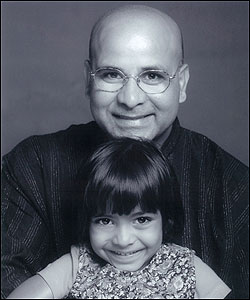
Rahul Varma with daughter Aliya
Deepa Punjani (DP): This will be the second time that your play BHOPAL will be staged in Mumbai. The first show was a production (translated into Hindi as ZAHEREELI HAWA) by the Late Habib Tanvir's Naya Theatre and was staged at the Prithvi festival in 2004. For this production, was Joanna Sherman, the director in consultation with you?
Rahul Varma (RV): I first learnt about the Bhopal gas disaster on TV in Montreal. I watched images of mass destruction. Pained and disturbed by the horrific images, I wondered what I could do. What would be a creative response from so far away? That very night, I wrote a one page story line, which I showed to Habib Tanvir during one of his visits to Montreal. Based on that storyline, he conducted a workshop that was a critical step in writing this play. His main point was to pose questions not posed by others, and examine issues ignored by the governments.
Tanvir's idea corresponded with the play's plot. What I wrote then, was a fictional plot rather than a documentary recounting the events. We agreed that fiction would permit us to pose new questions and arrive at the truth behind the disaster. The quest for the questions was precipitated by the image of a child named Zarina, which I saw in a hurriedly made documentary film called 'Bhopal: Beyond Genocide' by Tapan Bose and Suhasini Mulay. The film traced the 18 days of Zarina's life, who was one of thousands of babies born after the explosion.
The film showed Zarina's heart-wrenching body - her heaving ribcage and her collapsed heart that could be seen through the lesion on her melting skin. Her autopsy report said, ''Poisoned in her mother's womb''. I asked myself if Zarina had lived to tell, how would she describe her pain? Well, she didn't live and at 18 days, she was too young to say anything. What could have been said, then, became my creative response culminating in the form of a play which was translated into Hindi as ZAHREELI HAWA by the iconic Habib Tanvir. That this play had his blessing, is one of the greatest honours I have received.
Under Tanvir's direction, ZAHREELI HAWA was shown at the Prithvi festival. My actor-friend David Francis from Canada, and Terry Allen from the US acted in it. Tanvir's production was well received by the Indian audiences. The NCPA production of BHOPAL is sponsored jointly by Joanna Sherman's Bond Street Theatre, New York, and Dipan Roy's Epic Actors Workshop, New Jersey. The two companies decided that Joanna will direct the play, and I was consulted. I saw Joanna's take on BHOPAL in New Jersey, and was impressed. Her production was very different and fresh from all the other productions I had seen. Joanna adds Bond Theatre's unique style to the character-based play in a very gripping manner.
DP: Drammon theatre in Hyderabad is also working on a production of the play. Would you consider BHOPAL to be your most successful play thus far?
RV: Prior to Dramamon Hyderabad, Bhopal was produced by the Masquerade Theatre and The Madras Players in Chennai (2011). Dushyanth Gunashekar directed the production. Harika Vidula Stephen, who was part of his team, was so impressed, she pitched the play to Dramanon Hyderabad and the production will open on December 15. Harika has plans to take the play to other cities. I also know that Amritsar-based director Kewal Dhaliwal is translating the play in Punjabi and there will be a production in Amritsar. My company Teesri Duniya will have a three-week run in spring 2014. So from the perspective of the number of productions, and translations in different languages, yes, BHOPAL has been one of my most successful plays.
DP: You co-founded Teesri Duniya in Montreal in the early eighties. It was regarded at the time as a distinctly South Asian theatre group but that's not the case now with its multicultural identity. How did the transition come about?
RV: Canada is home to many cultures from all over the world, and they have fascinating stories to tell. I wanted to expand the cultural horizons of Teesri Duniya to present stories not told and cultures not represented. So Teesri Duniya became one of the few theatre companies in Canada, and the only one in Quebec, producing works by, for and about visible minorities while sharing the stage with dominant cultures.
DP: Any challenges that you faced in particular when you first started doing theatre in Montreal?
RV: When I started, there was no arts funding for non-European work. Now there is. Although we have public funding for the arts in Canada, culturally diverse theatres are underfunded. And politically relevant works pose a different challenge, which is an age old question in the world of theatre.
DP: Your company also publishes a quarterly magazine called 'alt.theatre:cultural diversity and the stage' - a magazine that purports to "examining intersections between politics, social activism, cultural plurality and the stage". Are these intersections more specific to Montreal and the region of Quebec or do the articles also reflect theatre from other cities and regions in Canada, and from elsewhere too?
RV: Our magazine alt.theatre is a national magazine. We regard cultural diversity as a national phenomenon, but we also know that there is a strong nationalist movement in Quebec, which resists acknowledging diversity. This is a big question and cannot be covered in a short interview.
DP: Has the global recession of 2008 and a slowing economy since then affected theatre companies in Montreal?
RV: Yes. We have seen cut backs, and reduced number of productions.
DP: What are you currently working on?
RV: I am doing post production writing of my latest play STATE OF DENIAL that is about genocide and gendered violence. In terms of new work, I am writing a play about marital problems, titled DIFFICULT BRIDE. It is a play which examines an immigrant bride's struggle to find her rightful place in society against the backdrop of race, gender and cultural traditions. I am hoping this will be a funny one with a political tilt.