Snyposis of BEGUM BARVE
Act One
As the curtain rises after the song of invocation, the Sutradhara enters, hoping to do his conventional duty of introducing the play. He waits for his beloved, as convention has it, and delivers the customary speech reprimanding her lovingly for the delay.
But, she does not come. Instead a middle aged, middle class, ordinary man comes and he too waits. The conversation between the Sutradhara and the ordinary man, in which both talk at cross purposes, across dramatic conventions, clarifies that the old dramatic convention is subverted.
The second man, very much like the first ordinary man, enters. They are friends, one is Bawadekar, and the other Jawadekar, both clerks in a government office, living in the same room, are bachelors and ensconced in the Marathi middle class life of doing their jobs faithfully and indulging in mild fantasies about marrying some suitable bride.
Today is a special day though. It is Thursday, the day dedicated to the deity Dattatreya. They will go home, garland the idol, burn an incense stick and eat the grams and jaggery, and pray. Who knows what will happen?
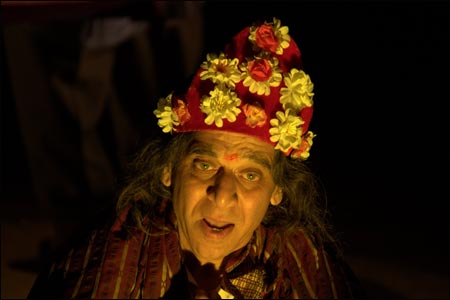
As the Sutradhara, who has been watching the pair, leaves, disappointed that his beloved will not come, the drop curtain rolls up revealing a strangely beautiful man, singing a song from a well known musical play of the past, when female impersonators
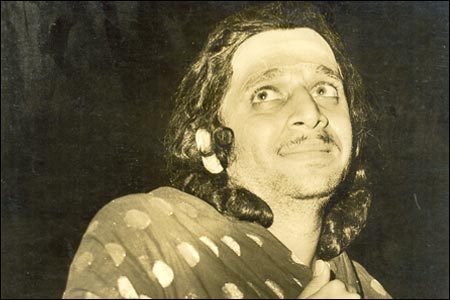
performed women's roles on stage. This man, now in his middle age, is a relic from that time in the past, but is still lost in it reminiscing the golden days of the Sangit Natk when the "star-heroine" Balgandharva enlivened the female characters and filled the auditorium with his divine music. This man on stage (Barve) was nothing but a minor actor, now singing the same songs which are the hallmark of Marathi dramatic tradition.
His nostalgia breaks as the erstwhile Sutradhara enters now as Shyamrao, a violent tempered gambler who lives off Barve's labour of selling incense sticks. Shyamrao was a horse cart driver, but is now paralyzed. He routinely looses in the gambling game. But he is also Barve's patron and lives with him under the staircase of the apartment in which the two clerks live. Barve is Shaymrao's 'Begum'. Today, Shyamrao is angry and hungry. He demands to be fed.
Cowered down Barve goes to the clerks apartment hoping to take from them the leftover savouries. As Barve enters the apartment, the clerks see in him Mrs. Nalawade, the widowed lady-clerk in their office. They had been fantasizing about her and she is actually there! Bearing a pot of water on a hot day and singing the romantic songs.
In a fully Marathi romantic scene Jawdekar declares his love for Mrs Nalawade. "She" accepts, but Barve has to go back to the waiting Shyamrao too.
Bawadekar, gratified at the turn of events rushes off to make arrangements for the wedding, and more importantly to inform the boss.
Barve returns and Jawadekar and Nalawadebai, who declares her name as Saranganayana, are married off.
The boss' sends his messenger. But the message is not the expected good wishes. It is a bolt from the blue. The note says that due to a mistake in the appointments one of the clerks is going to lose his job. The clerks are thrown off balance. The messenger too looks strangely like Shymrao. Who is he?
End of Act One
 Act Two
There is definite rift and mistrust between the two clerks. Their friendship alters as each one eyes the other suspiciously. Will they be able to call up support from someone in the Head Office?
Boss' man confronts Barve/ Nalawadebai, reminding her menacingly about coming over to the boss' bungalow as usual.
Jawadekar returns home and is confused by the presence of the boss' man. But there is good news for him. Saranganayana is pregnant. Jawadkar's joy sees no limits and they both get lost in daydreaming, with Saranganayana singing the classic theatrical lullabies
Bawadekar too is happy. But as he goes out he meets the boss' man. The boss' man plants the idea that Nalawadebai might have been pregnant from the boss.
Meanwhile Jawadekar and Sarangasnayana go through the happy rituals of pregnancy, ready to celebrate the seventh month ritual.
Decked in flowers Saranganayana sits on the swing, while Jawadekar pushes the swing lovingly.
Bawadekar enters in a dangerous mood. Jwadekar had better resign from the job, so that Bawadekar can keep it. Or else he would reveal the secret of Saranganayana Nalawade's pregnancy! Jawadekar agrees to sign.
At that moment Shyamrao enters looking for Barve, his Begum. He strips Barve off his fantasy and robes, humiliating him and scorning his male body.
He also brings with him the news from the boss that the jobs are safe. There is a GR to prove that.
Humiliated, Barve accepts his lot.
The clerks talk of "re-examining everything"
Shyamrao demands that his Begum go with him
Stripped to his identity Barve is the first to break out of the dramatic fantasy. He sings the valedictory song as others join him.
End of Act Two
**Synopsis by Urmila Bhirdikar, Pune
Begum Barve, Playwright, Theatre Academy, Pune,
Music, Balgandharva and Gadkari
Begum Barve: Play was written in 1979 for Theatre Academy, Pune Directed by Satish Alekar with Mohan Agashe as Shyamrao and Chandrakant Kale as Barve. Marathi production premiered in Delhi at Shree Ram Centre on March 19, 1979. Music by Rajiv Paranjpe. Original Marathi production participated in various national theatre festivals in India at Delhi, Mysore, Agartala (Tripura) and so on.
Gujarati adaptation by Sushila Joshi was directed by Paresh Nayak. Produced by Nandi Theatre, Ahmadabad and premiered on April 2, 1983. Another Guajarati adaptation by Chandrakant Shah was performed as Master Fulmani on November 15, 1999 in Mumbai produced by Ideas Unlimited, Mumbai. Master Fulmani was directed by Manoj S. Shah completed more than 100 shows.
Hindi translation by Vasant Deo was directed by Amal Allana. Play was produced by Theatre and Television Associates. Premiered on August 31, 1996 with Manohar Singh as Barve. Play completed more than 50 shows and participated in various national and international theatre festivals.
English translation by Shanta Gokhale was directed by Satish Alekar with all American cast for Department of Theatre and Film Studies, University of Georgia, GA, US in 2005. This was the first International production of Begum Barve completed 8 shows in October 13 - 23, 2005 at the Cellar Theatre, UGA Campus at Athens, GA, US. Satish Alekar was Adjunct Professor at UGA during fall 2005.
Bal gandharva /Narayanrao: Narayan Rajahans alias Balgandharva (1888-1967) is one of the most honoured names associated with the golden era of Marathi stage. He was gifted with a beautiful face and golden voice that enabled him to play female roles with astonishing success. He founded his own Gandharva Theatre Company. Lokmanya Bal Gangadhar Tilak, well-known thinker, scholar and pioneer figure in the freedom struggle against British rule much before Mahatma Gandhi, gave him the title "Balgandharva" (Little Angel) when he heard him sing at the age of ten. Balgandhava's costumes, jewelry and coiffure, and his distinctive manner of walking and talking in his roles as female lead in several popular plays of his time set the ultimate precedent in fashion statement and upper-class etiquette.
Gadkari: Ram Ganesh Gadkari (1885-1919) was a popular playwright of modern Marathi literature. He also wrote poetry under the name GOVINDAGRAJ. Balgandharva acted and produced many of his plays. Actors used to refer Gadkari as "Gadkari Master" (Gadkari Teacher) because he used to teach them diction.
About the Music: All the songs in the play are from the traditional Marathi musical plays written and composed from 1880 to 1919. These songs are composed and tuned by great Hindustani classical masters of that era. These songs are still popular and now have joined the repertoire of Hindustani classical concerts. The organ is the main accompanied wind instrument along with the percussion tabla and a string instrument sarangi or violin.