|
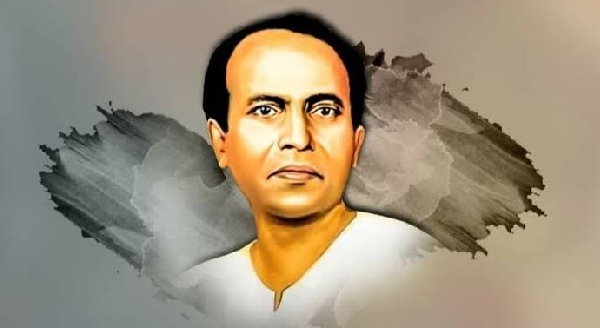
On the 106th anniversary of his birth, the state that once jailed him for singing now lays foundation stones in his name.
Chief Minister of Maharashtra Devendra Fadnavis and Deputy Chief Minister Eknath Shinde unveiled the 3D model and stone plaque for what will become the Sahityaratna Lokshahir Anna Bhau Sathe Research and Training Institute, a project of the Slum Rehabilitation Authority, timed to precede, by a single day, the hundred and sixth anniversary of Annabhau Sathe's birth. In Pune, meanwhile, a communal feast called 'Ekta Misal' (unity misal, also a dish that is itself a kind of argument for mixture) brought people across caste lines together in his name.
This year as every year, floral tributes from the high and mighty, official quotations of his most famous line about the earth resting not on the hood of the mythic serpent Sheshnag but on the palms of working people, and then, in all likelihood, a year of silence before the next anniversary arrives to revive him again.
It is worth sitting with the strangeness of this arrangement, because Annabhau himself would almost certainly have noticed it. Here was a man who spent his adult life being arrested, surveilled, and dismissed by the colonial and post-colonial state alike. The same Lokshahir is now being commemorated by that same state's most senior officials, in a ceremony organised by an authority whose business is slum rehabilitation—an institution whose very existence testifies to the fact that the Bombay chawls and labour camps that Annabhau wrote about have never entirely gone away. The earth may rest on the palms of the working people, as Annabhau insisted in 1958, but the palms in question are still, a century later, mostly unphotographed at the ribbon-cuttings which are hosted in their honour.
Annabhau was born on 1 August, 1920, in the village of Wategaon, in Sangli district, into a Matang family. This is a community counted among the untouchables, for whom formal schooling was less a right than a provocation. He lasted one day in the village schoolroom before untouchability ended his education outright. What followed was not the tidy origin story that anniversaries tend to prefer, but something more brutal and cruel. Poverty and famine drove his father to walk the family toward Bombay, and the journey itself, contrary to some of the more romantic retellings, was not a simple march but a six-month ordeal. Annabhau was hungry, largely barefoot, the family at one point detained in a camp for so-called 'criminal tribes,' a colonial classification that treated entire itinerant and nomadic communities as inherently suspect. They reached Byculla only in 1931. Annabhau was eleven.
What the young Annabhau did next in Bombay reads less like the biography of a future literary giant than like a testimony of the city's most exhausted and expendable labour: he worked as a porter, a watchman, a shoeshine boy, a coal loader, a daily-wage laborer, a babysitter, a hawker, a mill hand. This is worth dwelling on, because the anniversaries tend to compress this period into a single sentimental song (a poor boy who taught himself to read) without registering what that destitution embodies (and erases). Annabhau did not simply arrive in Bombay and discover literature. He spent years on the gullies and khopchas of the city's most precarious work before anyone taught him to make sense of a written sentence, and when that teaching finally came, it came not from an institution but from another worker: a man of the Mahar caste who, according to several accounts, showed him how to sound out the letters on shop signs and street placards.
Once, Annabhau was observed holding a newspaper upside-down by a prominent Gujarati writer who, realising the 'budmaashi', the writer offered to teach him. Annabhau first mastered the Gujarati language before his maternal cousin taught him the Marathi alphabet. The point is, Annabhau's literacy, in other words, was assembled out of storefronts and street corners rather than classrooms.
Also Read: Tribute to Annabhau
The Bombay he was teaching himself to read in was already, by the time he arrived, a city which was revolutionised with organised labour. Textile workers had begun mobilising as early as 1929, energised in part by the distant example of the October Revolution of 1917 and the promise it seemed to hold for a working-class future. Annabhau grew into this atmosphere rather than merely observing it; he became, in relatively short order, an active participant in the communist movement that was reshaping the city's mill districts.
His time in the mills directly propelled him into the communist and labour movements, where he became a key activist. He was influenced by the ideologies of Mahatma Jyotirao Phule, Babasaheb Ambedkar, and Marx. Ballads and powadas were the weapons in Annabhau's armoury through which political demands were shaped and voiced.
Sathe's political conscience was not confined to local disputes. His intellectual output spanned global issues, he wrote a Powada in 1939 on fascism in Spain and its effect on the working class, followed by his legendary ballad on the Battle of Stalingrad in 1943. However, his work drew the ire of authorities. In 1946, during an election campaign in Amravati, the Lal Bawta Kala Pathak was charged and arrested as 'dacoits' rather than as political agitators. Annabhau's argument was simple: Works of art can not only save us, but they can also make the working class more sensitive to what needs repair.
Annabhau's work multiplied. His trajectory (child labourer to self-taught reader to committed organiser) is staggering. Thirty-five novels, the powadas, the plays, the travelogue, the reception in Moscow. All this feels less like a fairy tale of individual genius and more like the logical, if improbable, culmination of a specific political education conducted entirely outside the institutions that were supposed to provide one.
He called himself, and was called by others, several things at once: Lokshahir, the people's bard; Sahityaratna, the jewel of literature; and, without any sense of contradiction, comrade. His literary output spanned an almost bewildering range of forms-kathas, kadambaris His literary output spanned an almost bewildering range of forms-kathas, kadambaris (novels), powadas, lavanis, shahiri performance, and loknatya, the people's theatre he helped invent by taking the tamasha stage's popular, sometimes disreputable entertainments and loading them with the argument of class struggle. His masterwork, the 1959 novel Fakira, follows a young man from a marginalised community who takes up armed resistance against British authority to feed his starving people, and it remains a landmark precisely because its hero is never permitted to be merely pitiable. Annabhau's characters, across dozens of novels, are not victims awaiting rescue. They are Bhagat Singh and Ramprasad Bismil, rolled into one.
Protest was never abstract for him. His art and his organising were a single continuous act, and it cost him accordingly: in 1946, campaigning with his performance troupe for Communist candidates in Chandur Bazar, in what was then the Central Provinces, he was arrested-not on any political charge, which might at least have honoured the seriousness of his politics, but on a fabricated charge of dacoity, banditry, a colonial-era legal fiction that authorities found convenient whenever they wished to silence a political troublemaker without the inconvenience of making a martyr of him. He was released only after sustained pressure from labour unions.
The emotional core of this struggle was famously captured in his ballad Majhi Maina Gavavar Rahili (My Maina has been left behind in the village) in which Annabhau deployed the chakdi-form most poignantly. Though misunderstood by many as a romantic lamentation of a worker separated from his wife, the song is a potent political metaphor, expressing the grief of the working class separated from their rural homes as well as the border regions (like Belgaum) during the fight for Mumbai.
None of this is to say the commemorations are worthless. A 3D model and a stone plaque are not nothing, particularly for a writer whose community was for so long denied even the basic dignity of being read. But there is a real question buried inside the ceremony, one that the satirists among Annabhau Sathe's admirers have already started to ask aloud: whether the 'high and mighty,' in the words of one pointed tribute circulating this anniversary, can offer floral garlands to Annabhau Sathe while the actual content of his work (the powadas about mill workers, the tamashas that mocked the wealthy, the loknatya that turned courtesan-associated folk forms into vehicles of class argument), goes conveniently unread.
It is one thing to quote the line about Sheshnag's hood at a ribbon-cutting. It is another to sit with what Annabhau Sathe actually meant by it: that the state's platforms, its plaques, its institutes, are not where his idea of literature lived. It lived in the labour camps near Sion, in the chawls of Girangaon, in a song sung by a migrant worker missing his wife back in the village, passed mouth to mouth by people who could not read the novels but somehow needed no help understanding the ballads.
Annabhau Sathe transformed the traditional Marathi folk theatre, Tamasha, into Loknatya (People’s Theatre). He stripped away the original form’s vulgarity while retaining its vibrant musical structure, pivoting the content entirely toward social and political issues. How Annabhau subverted the art form’s traditional conventions, notably by shifting the opening divine invocation (Gan) from a prayer to Lord Ganesha to one dedicated to the labouring hands of humankind, celebrating those who built world civilisations. This was an important turning point in the history of the performing arts in India. Annabhau was our desi Bertolt Brecht.
Annabhau Sathe challenged the curious notion that we cannot change the past. For most Indians, the past is fixed, for Annabhau Bhau the future is open. I recall a conversation with Jnanpith award winner Vinda Karandikar who said, 'Annabhau Sathe is today's Tukaram. He is a Vidrohi Tukaram. Every time I encounter Annabhau's words, I think we have underestimated his cultural clout and literary importance.'
'Tis true. And this is the Annabhau we would need to remember.
# Ramu Ramanathan is a journalist
|