|
Reading Shakespeare's quiet elegy to Christopher Marlowe in As You Like It, playwright Ramu Ramanathan found himself asking the question which Elizabethan England never had to answer aloud: what does a state do with a playwright it can no longer control?
Before Shakespeare gave English drama Hamlet’s hesitation or Macbeth’s ambition, Christopher Marlowe had already given it something rarer: a voice. He was the one who first bent the ten-beat line of blank verse into something that could rage, seduce, and blaspheme in a single breath. This was an iPhone moment for the theater. Marlowe was the one who first dared to let a villain win. His mantra: 'Write the devil sympathetic, and the audience learns to distrust the priest instead.'
But why am I talking about Marlowe?
Well, six years after Marlowe bled to death from a single stab wound above the right eye in a rented room in Deptford, William Shakespeare slipped a quiet elegy into a comedy. In As You Like It, Phoebe recites a line from Marlowe’s Hero and Leander. He says, 'Dead shepherd, now I find thy saw of might, / Whoever loved that loved not at first sight?'. Elsewhere the play murmurs of 'a great reckoning in a little room,' the very room in which Marlowe was killed.
This is as close as Shakespeare ever came to writing a gravestone: for the man who taught him how a line of verse could carry a soul, tragic or damned, and who never lived to see how far that lesson would travel. It’s an important lesson about how playwrights can doff their hat to fellow playwrights; especially under an oppressive regime.
So who was Christopher Marlowe?
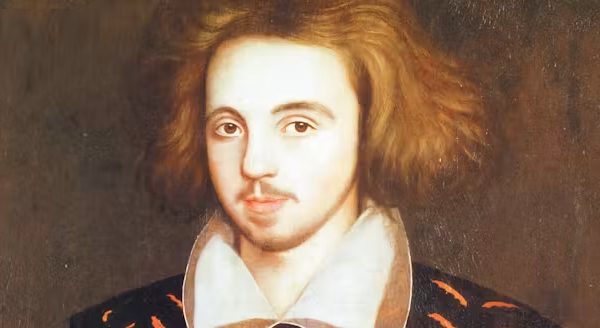
In the summer of 1593, a bricklayer’s grandson from Kent turned into England’s most dangerous man. Christopher Marlowe was twenty-nine, the son of a shoemaker, and by then the most celebrated playwright in London. This was a title he would hold for exactly one more week. Then, in a rented room in Deptford, a dockside village on the Thames, a man named Ingram Frizer drove a dagger into his right eye, and Marlowe died before supper was cleared away. The coroner called it self-defence. History has spent four centuries calling it political assassination.
For an Indian theatrewallah, there is something oddly familiar in this story, and not merely because we, too, know what it costs a writer to say the wrong thing to the wrong audience. Marlowe’s England was a surveillance state. Elizabeth I sat on a throne; and like most rulers, she was not sure how long she would reign. One reason was she was being watched by the Pope’s men from Spain and Rome. These men considered her illegitimate and her death no sin. To defend her, Sir Francis Walsingham built one of Europe’s first modern intelligence networks. This included: informers in taverns, agents provocateurs in seminaries, a bureaucracy of suspicion that ran, quite literally, through the universities.
Enter Christopher Marlowe.
He was brilliant and poor. He was the kind of bright-brash man that the network wanted: fluent in Latin, hungry for money, the center of attraction. Cambridge’s own attendance ledgers show him disappearing for months at a stretch, his food bills, meanwhile, suspiciously lavish for a scholarship boy living on four pounds a year. When the university balked at granting his degree over rumors he’d defected to a Catholic seminary in France, the Privy Council itself wrote back, coldly, that Marlowe had 'done Her Majesty good service' in 'matters touching the benefit of his country.'
By what was Marlowe actually doing? Biographers from Anthony Burgess to Charles Nicholls have speculated, and the Protestant state left it unexamined. But that Privy Council letter is one of the strangest documents in English literary history: an intelligence service, essentially, forging an alibi for its own spy asset.
Marlowe was the Samay Raina of his times. He took that edgy, uneasy relationship with power and plonked it directly on stage. Tamburlaine, his first hit, gave London a conqueror who defies God, burns the Quran in open defiance, and is never punished for any of it. Marlowe dramatised a scandal; but he was smart enough to dress it as entertainment. In The Jew of Malta, his villain Barabas is the only honest man in a city of Christian hypocrites. In Doctor Faustus, a scholar sells his soul. And Marlowe’s genius is, he lets him go to hell without flinching from the horror of it. This was not a moral science classroom dressed up as drama, which was what English theatre had mostly been until then. This was a playwright using the stage to interrogate the very state whose secrets he carried, and daring the censor to notice.
Eventually, someone did. In May 1593, with London gripped by plague and a wave of anti-immigrant panic, an inflammatory verse threatening violence against Protestant refugees was nailed to a churchyard wall. It was signed with the name of Marlowe’s own stage villain. Marlowe’s former roommate, the playwright Thomas Kyd, was arrested and tortured until he produced 'heretical papers.' Kyd swore that the papers belonged to Marlowe, not him.
A government informer named Richard Baines then filed a report accusing Marlowe of a string of blasphemies. These were: Moses was a conjurer, that the Bible was badly written fiction, and that religion existed only to keep men afraid. In an England where atheism was treated as treason, this was, quite literally, a capital case. Marlowe was summoned before the Privy Council and ordered to report to them daily.
Ten days later, Christopher Marlowe was dead in a private house, in the company of three men who worked, in one capacity or another, for the state’s own intelligence apparatus, over what the record insists was an argument about the bill.
Three witnesses, all professional liars by trade, told an identical story. As a friend of mine, a professional law-maker said to me, 'If I bring you three witnesses to a killing and their statements match each other word for word, down to the placement of the furniture, I do not write ‘corroborated.’ I write ‘coached.’ Human memory does not agree so precisely by accident.'
It’s a fair point. No one else was in the room. And the three witnesses who agreed on everything have usually agreed beforehand. The coroner, appointed by the Crown, conducted his inquest largely alone and delivered his verdict in days. Ingram Frizer had a royal pardon within a month and later became, of all things, a respectable parish tax assessor.
What makes Christopher Marlowe’s story worth telling to an Indian audience is not simply the gossip of Elizabethan espionage. It is the lesson for theatrewallahs in the here and now. A state that finds a writer useful will protect him, right up until the moment his usefulness is outweighed by what he knows or what he has dared to say aloud, in a tavern, at a dinner, or in a play the praja loved a little too openly.
The tragedy of Marlowe is not that he was killed. It is that no one with the power to save him thought it urgent enough to try. He died in an unmarked grave, denied a Christian burial for suspected heresy, at twenty-nine. But he left behind a body of work so far ahead of its time.
He taught the English stage to speak in a voice large enough to hold gods and traitors in the same breath, and having taught it. Four centuries on, wherever an actor draws a line of unrhymed verse out long and lets it break like a wave against the footlights, some particle of Christopher Marlowe is still alive.
# Ramu Ramanathan is a journalist and a playwright
|