|
What happens when a traditional performance form begins to discover new ways of showing not just action, but memory, dreams and thought? In The Old Man and the Sea – Kathakali of the Morrow, an adaptation directed by Kalamandalam Neeraj Mohandas, the experimentation begins within the form itself.
The production does not attempt to abandon Kathakali's established visual language. Instead, it asks how that language can accommodate ideas that have rarely, if ever, been presented through it. A dream, a thought, a memory of the past — these become theatrical possibilities.
Neeraj describes this as an attempt to introduce ideas that Kathakali has not traditionally used in this manner. "I try to present some other ideas we never use in Kathakali before, like to present a dream in Kathakali," he says, adding that he also wanted to explore "how you present the thing, the thoughts, the past, past thoughts are present."
It is an important distinction. The experiment is not about changing Kathakali into something else. "I don't try to change the structure and the costumes of Kathakali," Neeraj says. "But I'll try the new ideas to present through the Kathakali."
That approach becomes particularly significant because Hemingway's novella is itself not a conventional action-heavy narrative. Much of its dramatic force lies in Santiago's physical struggle, his memories, his thoughts and his relationship with the sea. Translating that interior world into a performance form traditionally associated with highly codified characters and stories demanded a different kind of theatrical thinking. The changes, however, extend well beyond what happens within a character's mind. The physical relationship between performer and spectator was also reconsidered.
In a conventional Kathakali performance, the audience watches from outside the action. Here, the boundary is deliberately made porous. Neeraj recalls discussing the idea of the fourth wall and says that in a conventional performance, "There is no responsibility for the audience." The challenge, therefore, was to make spectators more conscious of their place within the theatrical space.
The idea had begun taking shape even before The Old Man and the Sea, through another production. "We discussed a lot about the 4th wall of the stage," Neeraj says. That thinking eventually informed the new production, where the audience would not simply sit facing a stage and watch the action unfold at a distance.
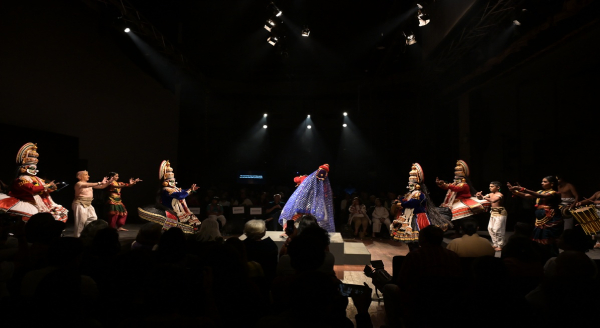
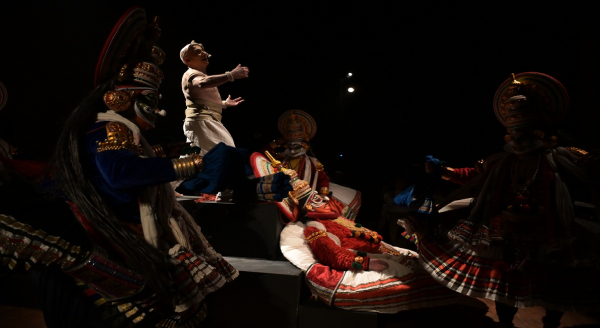
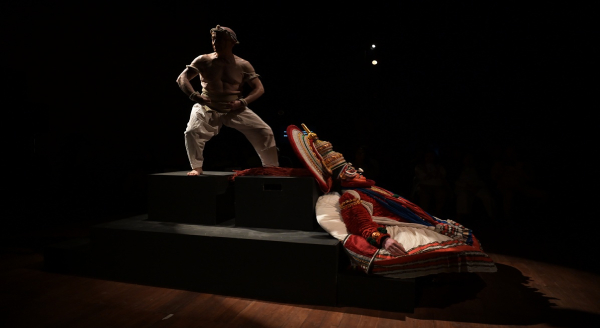
Instead, the space was rearranged. The audience sat on different sides, while the performers occupied and moved through multiple areas. The singers faced each other from opposite sides. What might conventionally have been understood as the stage became a collection of performance spaces, with darkness separating some of these temporary islands.
Mohandas Romanta, who wrote the Kathakali text, recalls the original conception of the production in equally spatial terms. "The ocean itself and the audience itself should be transformed into the ocean," he says.
That single idea altered the relationship between the story and its spectators. Santiago does not merely enter an imaginary sea located somewhere in front of the audience. The sea surrounds them. The performers can approach from different directions, and the spectators can find themselves uncertain about where the performance begins and ends.
Mohandas describes the effect as an "illusionary stage". He says that even those involved in creating the production experienced moments when they felt uncertain whether they were part of the play or simply observing it.
Neeraj deliberately placed himself outside the performance as director. That was not simply because he had chosen not to act. He wanted to see the production from the perspective of someone watching it for the first time.
"Direction is not just what we see on stage," he says, pointing to the considerable work that happens away from the performance itself. But there was another reason for his decision. As director, he needed to watch the performance as an audience member and assess whether the unusual spatial arrangement was actually working.
The darkness between the illuminated performance areas became part of that vocabulary. Mohandas notes how these temporary or supplementary stages could be separated by darkness, creating an effect in which even a moving scene appeared to shift through space.
The same philosophy informed the treatment of silence. In a production where the sea, the movement of characters and the physicality of Kathakali could easily have encouraged a dense musical treatment, silence was sometimes deliberately allowed to dominate.
"It is silence that gives more effect to the scene than any kind of percussion or sound or music from the background," Mohandas says.
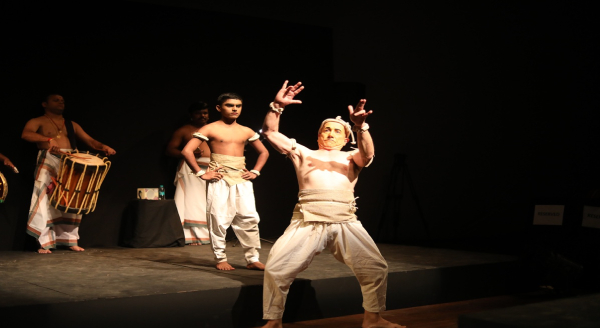
The performers, too, had to adapt to this new theatrical environment. The casting itself reflected the willingness to move beyond predictable choices. Italian theatre practitioner Mario Barzaghi became Santiago, despite the obvious language and cultural challenges involved in entering the world of Kathakali.
Neeraj describes him as "very friendly and talented", before adding with characteristic candour: "But we fight a lot." Barzaghi bagged the best male actor award at the META Festival in New Delhi earlier this year.
The collaboration required considerable patience. Barzaghi stayed near Kalamandalam and worked extensively with the team. Malayalam and Manipravalam (the language in which Kathakali stories are written) presented an obvious barrier, but the challenge was larger than language. He had to absorb the physical vocabulary of Kathakali and make it his own.
Neeraj recalls spending two or three hours with him before and after regular rehearsals. Barzaghi worked on his own physical exercises while also practising Kathakali exercises. The process demanded both physical and mental flexibility.
The production's approach to character was similarly exploratory. The sea and the marlin, neither conventional human protagonists, were brought into the theatrical world as characters. This was not entirely alien to Kathakali, which has long had a vocabulary for animals, birds, gods and even forces of nature. But here that vocabulary was being employed in the service of a very different story.
The same tension between tradition and experimentation can be seen in the costumes. Neeraj deliberately resisted the temptation to radically redesign Kathakali. The performers representing Santiago and Manolin did not use the elaborate conventional makeup associated with many Kathakali characters, while the sea, marlin and sharks retained the visual vocabulary of the form.
The result is not a rejection of tradition but a test of its elasticity. That may ultimately be the most interesting aspect of this production. The creators did not begin with a desire to modernise Kathakali and then search for a story to fit the experiment. Instead, the demands of the story gradually pushed the form towards new possibilities.
Mohandas describes this process as something that evolved through rehearsal. There was no rigid blueprint governing every character or movement. "It was the script itself evolving," he says elsewhere in the conversation, explaining that the work developed through discussion, rehearsal and adjustment.
Neeraj puts the creative process even more instinctively: "The script will tell you."
That principle explains why The Old Man and the Sea feels less like an attempt to make Kathakali contemporary and more like an attempt to discover what else Kathakali can do. For Neeraj, the ambition extends beyond this single production. He wants audiences outside Kerala and India to encounter the form and understand its possibilities. "I would like to get more audience from all over the world to know in Kathakali, to watch the Kathakali and enjoy the Kathakali," he says.
Perhaps that is where the production's experiments with flashback, dreams, space, silence and spectatorship ultimately converge. The form remains recognisably Kathakali, but the theatrical contract around it has changed.
The audience is no longer simply outside looking in. The stage is no longer a fixed rectangle. The past need not remain merely spoken. A dream can become performance. Silence can become sound. And the sea can surround the spectator.
Kathakali has not been dismantled. It has been asked to look beyond its familiar boundaries.
|